
There are thousands of “start a blog” guides on the internet. Most of them are the same article recycled with a different year in the title. This one is different — not because I’m claiming to have magic secrets, but because I’m going to tell you the things most guides skip: the wrong turns, the realistic timelines, the tools that actually work versus the ones that just look good in affiliate roundups, and the specific ways AI changes the equation in 2026 versus how it worked even eighteen months ago.
AI has genuinely transformed blogging, but not in the way most people think. It hasn’t made blogging easier in the sense that you can now press a button and get a successful blog. It has made the execution of a good strategy dramatically faster. The strategy itself still requires your brain, your judgment, and your willingness to understand your audience. What used to take a team of writers, an SEO consultant, and a social media manager can now be handled largely by one person armed with the right tools and a clear plan.
| 📌 Who This Is Written For This guide is written for people starting from zero, but it’s not dumbed down. Whether you’ve never bought a domain name or you have an existing blog that’s stalled out, the frameworks here apply. If you’re an absolute beginner, read every section. If you’re relaunching, skim the setup sections and spend serious time on Steps 4, 5, 7, and 11 — those are where most stalled blogs go wrong. |
How to Start a Successful Blog with AI
Step 1: Choose a Profitable Niche — The Real Framework
Niche selection is the most consequential decision you’ll make, and it’s the one most guides treat as a quick bullet list. It deserves real thought because a bad niche doesn’t just slow you down — it guarantees failure, regardless of how good your content is or how hard you work.
The classic advice is to “follow your passion.” That’s only half true. You need genuine interest because you’ll be writing about this topic for years. But passion alone means nothing if nobody is searching for the topic, if there’s no way to make money from it, or if it’s so competitive that a new site can’t realistically rank within the first two years.
The Three-Filter Test
Run every niche idea through three filters before committing.
- The first is sustained interest: can you write 80 to 100 articles on this topic without running dry or losing your mind? Not 10 articles — a hundred.
- The second is searchable demand: are people actively typing questions about this into Google?
- And the third is monetization viability: is there a clear path to income, whether that’s affiliate products, display advertising, a course you could sell, or consulting? All three need to be present. Two out of three is a warning sign.

Using AI to Surface Niche Ideas You Wouldn’t Think Of
Start broad. Ask Claude or ChatGPT something like: “I have experience in [your background]. What are 15 underserved blog niches that intersect with this background, have growing search demand, and are not dominated by major media brands?”
The output won’t be a final answer — it’s a starting point. AI is excellent at lateral thinking here, surfacing intersections you wouldn’t immediately consider: not just “personal finance” but “financial independence for freelancers in their 40s”, not just “parenting” but “parenting with ADHD as the parent.”
The ideas AI gives you still need validation against real data. Run them through Google Trends to see a five-year trajectory — you want growth or stability, not decline. Then pull them into Ahrefs or Semrush and look at the keyword difficulty on the main head terms. If the primary keyword has a difficulty score above 70, that niche is almost certainly dominated by high-authority sites you can’t compete with in your first year. Look for niches where substantial clusters of keywords — not just one or two — sit in the 20 to 50 difficulty range. That’s your entry window.
The Micro-Niche Advantage

Google’s algorithm in 2026 rewards topical depth over topical breadth, especially for new sites. This means a blog entirely about strength training for women over 50 will outrank a general fitness blog on that specific topic, even if the general fitness blog has ten times the domain authority. The algorithm has learned to recognize narrow expertise, and it rewards it.
Starting narrow doesn’t mean staying narrow forever. Once you’ve built real authority in your micro-niche — typically 6 to 18 months in — you can expand outward. This is how almost every major blog started: tightly focused, then broad. The mistake most beginners make is trying to go broad immediately and building authority nowhere.
| 💡 A Niche Worth Fighting For A good niche has existing competition, active forums or communities, affiliate programs paying real commissions, and books or courses already selling on Amazon. Zero competition means zero market. Some competition is a feature, not a bug — it confirms people care about the topic. Your job is to serve the audience better than what’s already out there, not to find a topic no one has covered. |
Step 2: Pick Your Platform With Eyes Open
Platform choice is the second major decision, and unlike niche, it’s partially reversible — though migrating a blog is painful enough that you want to get it right the first time. In 2026, the landscape has evolved significantly. Here’s an honest breakdown.
WordPress.org: Still the Gold Standard, With a Caveat
Self–hosted WordPress still makes the most sense for bloggers who are serious about long-term SEO, full control over their monetization, and the flexibility to grow into something beyond a basic blog.
The plugin ecosystem is unmatched — nothing else comes close for the combination of Rank Math, WP Rocket, and the Gutenberg editor working together. The caveat is that WordPress has a real learning curve and requires you to care about things like hosting performance, plugin conflicts, and security. If the idea of managing a server-side software installation sounds genuinely overwhelming, that’s not a character flaw — it’s a real consideration.
The Modern Alternatives That Now Deserve Serious Consideration
Ghost has matured into an excellent platform for writers who want newsletter-first distribution built directly into their blog. Its speed, clean interface, and integrated membership features make it particularly well-suited to niches where email is the primary distribution channel — personal finance, productivity, career advice. The SEO capabilities have improved substantially, and for many niches it’s a completely viable alternative to WordPress.
Beehiiv deserves a mention for anyone whose strategy centers heavily on the newsletter side of blogging. If your monetization model involves newsletter sponsorships and paid subscriptions, Beehiiv’s tooling around those specific functions is best-in-class. Webflow and Framer have also emerged as serious options for design-forward bloggers who want visual control without touching code.
| Tool | What It Does Best | 2026 Pricing |
| WordPress.org | Full SEO control, endless plugins, scalable CMS | Hosting: $3–15/mo |
| Ghost | Writers, newsletter-first, fast, clean monetization | From $9/mo |
| Beehiiv | Newsletter + blog hybrid, sponsorship marketplace | Free – $49/mo |
| Webflow | Visual design control, powerful CMS, no-code | $14–23/mo |
| Framer | Design-first, modern, marketing sites | $10–20/mo |
| Squarespace | Easiest setup, portfolio-style, limited SEO control | $16–23/mo |
The honest recommendation for most readers: if you want a blog that ranks on Google, builds an audience, and has the flexibility to monetize in multiple ways, start on WordPress.org with a quality host like Cloudways or Hostinger. If you’re newsletter-first and your niche lends itself to that model, Ghost or Beehiiv are legitimate and often simpler paths. Don’t let platform anxiety delay you — a decent blog on any of these platforms beats a perfect blog that doesn’t exist.
Step 3: Set Up Your Blog the Right Way
The setup phase is where most beginners either rush through things that matter or obsess over things that don’t. Design is not what gets you traffic. A clean, fast, functional site is all you need to start. What matters here is getting the technical foundation right so it doesn’t haunt you later.
Domain Name

Your domain name matters less than you think for SEO and more than you think for branding. Exact-match domains (like best-fitness-tips.com) lost their ranking advantage years ago. What you want is something short, memorable, and pronounceable — something someone could remember after hearing it once in a podcast. Keep it under 15 characters if possible, avoid hyphens, and grab a .com unless there’s a genuinely compelling reason not to.
AI is actually useful here. Ask Claude to generate 30 brandable domain name ideas for your niche with the constraint that they must be under 12 characters, .com available, and not sound like SEO spam. Then run the best options through Namecheap’s bulk availability checker. The whole process takes 20 minutes.
Hosting, Speed, and Core Web Vitals

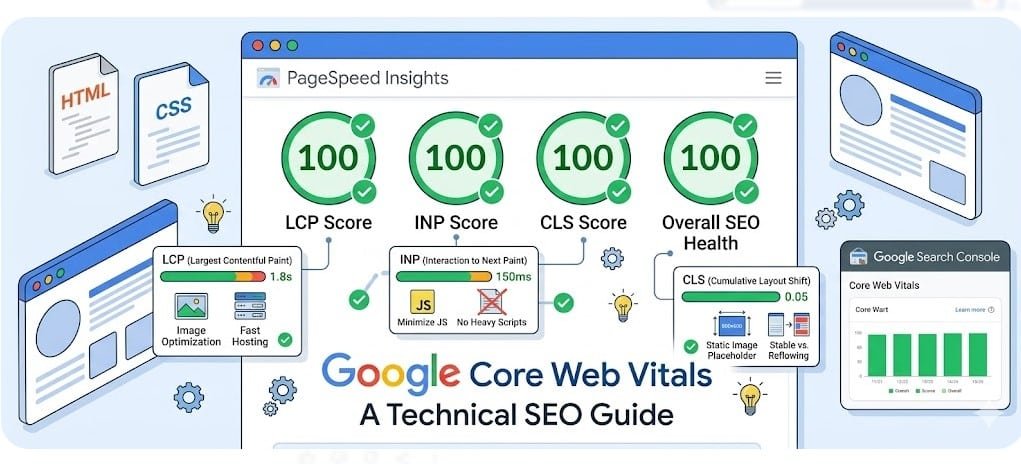
Site speed is a confirmed Google ranking factor, and it affects user experience just as much as it affects rankings. A page that takes more than 3 seconds to load loses over 50% of its visitors before they read a word. On WordPress, this comes down almost entirely to your hosting choice and a few key plugins. Cloudways (cloud-based, excellent performance, more control), Hostinger’s cloud plans (affordable, solid for new sites), and WP Engine (managed, premium, excellent support) are the three tiers worth considering in 2026.
Beyond hosting, install WP Rocket for caching and performance optimization, connect your site to Cloudflare’s free CDN, and compress every image before it goes anywhere near your media library. ShortPixel handles this automatically if you can’t remember to do it manually. These aren’t optional extras — they’re the baseline for a site that Google takes seriously.
Theme and Design
Use a lightweight, block-editor-compatible theme. GeneratePress, Blocksy, and Kadence are the three best options in 2026 — they’re fast, accessible, maintained actively, and work seamlessly with Gutenberg. Avoid anything that bundles a visual page builder (Divi, Avada, Elementor for complex layouts) into the theme itself. These tools add significant page weight and often create technical SEO problems that take months to diagnose. You can always make a simple theme look polished; you can’t make a bloated theme fast.
Essential Plugins for WordPress
Keep your plugin count low and purposeful. The plugins every serious blog needs: Rank Math SEO for on-page optimization, schema markup, and sitemap generation; WP Rocket for speed and caching; Cloudflare (the WordPress plugin, connected to your free account) for CDN and security; UpdraftPlus for automated backups (set to daily, stored somewhere off your server); and ShortPixel for image compression. Everything else is situational. Every plugin adds load; add only what earns its place.
Step 4: Build an AI-Powered Content Strategy That Compounds
Most bloggers treat content like a content mill — publish as much as possible, hope something sticks. That approach worked in 2014. In 2026, Google has become sophisticated enough to recognize and reward sites that build genuine topical authority, and to deprioritize sites that publish broadly without going deep.
Topical Authority: The Framework Behind Every Successful Blog
Topical authority is the concept that Google awards ranking power not just to individual pages, but to entire sites that demonstrate comprehensive knowledge of a subject. The practical implication is this: a site with 40 deeply interlinked articles about intermittent fasting will outrank a site with 400 articles covering intermittent fasting alongside 399 other health topics — at least on anything fasting-related.
The structural model that achieves this is called the pillar-cluster architecture. Pillar pages are long, comprehensive guides on broad sub-topics within your niche — think of them as the chapters of a book. Cluster articles are focused posts that go deeper on specific aspects of each pillar, and they link back to it. The internal links create a web of topical relevance that Google’s crawlers can follow and interpret. When you do this consistently across your entire content plan, you stop competing for individual keywords and start competing for entire topic areas.
Building the Content Plan with AI
AI makes the structural planning work fast. Give Claude or ChatGPT a specific prompt:
"I'm building a blog about [niche]. Create a complete topical authority map with 8 pillar page topics, and for each pillar, give me 6 cluster article ideas with the primary keyword and search intent for each."
You'll get a usable content architecture in minutes.
The important step is then taking each keyword into Ahrefs or Semrush and checking actual difficulty scores and search volumes before finalizing your calendar. Not every AI-suggested topic will be a viable target for a new site.
Prioritize your clusters by keyword difficulty. In your first 90 days, publish almost exclusively on low-competition keywords — difficulty scores under 25 if possible. These are your entry points: they get you crawled, indexed, and start building topical signals without requiring backlinks you don’t have yet. Once you have 20 to 30 published posts and a growing backlink profile, you can start targeting moderately competitive terms.
Content Types and Why They’re Not All Equal
Informational content — how-tos, guides, explainers, comparisons — is the backbone of a blog that ranks. It satisfies what Google calls “informational intent,” which makes up the vast majority of searches. These posts build traffic that compounds over time: a well-written guide published today can be your top traffic driver two years from now without a single update.
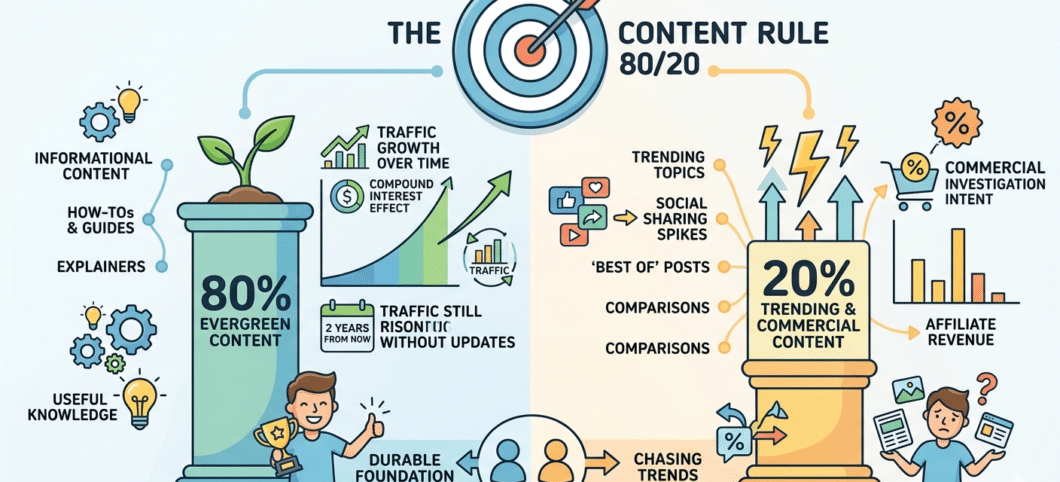
Comparison and “best of” posts serve commercial investigation intent: readers who are close to making a purchase decision. These convert well and drive affiliate revenue, but they require more effort to rank because every affiliate blogger is chasing the same keywords. Write them as genuinely useful decision-making tools, not as thinly disguised ad pages, and they’ll outperform the competition in the long run.
| 🎯 The 80/20 Content Rule Allocate roughly 80% of your content budget to evergreen informational content and 20% to trending, commercial, or opinion-driven pieces. The evergreen content is your compound interest — it grows in value over time with minimal maintenance. The trending content drives short-term spikes and social sharing. You need both, but new bloggers consistently get this ratio backwards, chasing trends at the expense of building a durable topical foundation. |
Step 5: Write Posts That Actually Rank — The Full Anatomy
Here’s what the top-ranking posts in 2026 have in common that most AI-generated content lacks: they’re written for a specific person, they answer a specific question more completely than any other result on the page, and they feel like they were written by someone who actually knows what they’re talking about. That last part is where human judgment is irreplaceable.
The Research Phase — Don’t Skip This

Before you write a word, spend 30 to 45 minutes reading the top five ranking pages for your target keyword. Not to copy them — to understand what questions they’re answering, what angles they’re missing, and where your post can genuinely do better. Look at the People Also Ask box in Google for that keyword. Check Reddit and Quora to see what real readers are confused about. This research phase is where you find the gaps that your post can fill — the specific insights, examples, or explanations that the currently ranking content doesn’t offer.
Perplexity AI is particularly useful in this phase because it synthesizes current information with citations, giving you a fast overview of a topic while pointing you to primary sources you can explore further. Use it as a research accelerator, not as your sole source.
Headline, Meta, and Structure

Your H1 headline needs to include your primary keyword naturally — not stuffed awkwardly, but placed near the beginning where possible. It also needs to signal a clear benefit or promise. “How to Start Intermittent Fasting” is functional but weak. “How to Start Intermittent Fasting Without Feeling Miserable in the First Week” is a headline that earns a click because it acknowledges a real fear the reader has.
Your meta description is your ad copy in the search results. Treat it that way. Under 155 characters, one clear benefit, and ideally a subtle differentiator from the other results on the page. Rank Math will show you a live preview as you write it.
The heading structure (H2s and H3s) should function as a standalone outline. A reader who only reads your headings should come away with a clear sense of what the full article covers. Google’s crawlers read heading structure to understand content hierarchy — a clear, logical structure signals that your post is well-organized and comprehensive.
The AI Writing Workflow That Actually Works
Here’s the specific workflow that produces high-quality content efficiently, without producing the generic, flat prose that AI tends to generate when given free rein.
Start by doing your own research and making notes — even rough ones. Then use AI to generate an outline based on the competitive research you did and the keywords you’re targeting. Evaluate the outline critically: does it cover the topic thoroughly? Does it have a logical flow? Adjust it before you start writing. Then write each section separately, using AI to generate a first draft of each H2 section. After each section, edit it — add your own examples, your own voice, your specific knowledge. This is the step most people skip, and it’s the step that determines whether your content is genuinely valuable or just verbose filler.
After the full draft is assembled, run it through Hemingway App to identify sentences that are too complex, and through Grammarly for technical cleanup. Then read the entire piece out loud. If it sounds like a textbook or a corporate press release, rewrite the awkward passages. Real readers can feel the difference, and so can Google’s quality assessors.
E-E-A-T: The Ranking Signal That Can’t Be Faked
Google’s Quality Rater Guidelines use a framework called E-E-A-T: Experience, Expertise, Authoritativeness, and Trustworthiness. This has become increasingly important in 2026 as AI content has flooded the internet and Google has doubled down on rewarding content that demonstrates real human knowledge and experience.
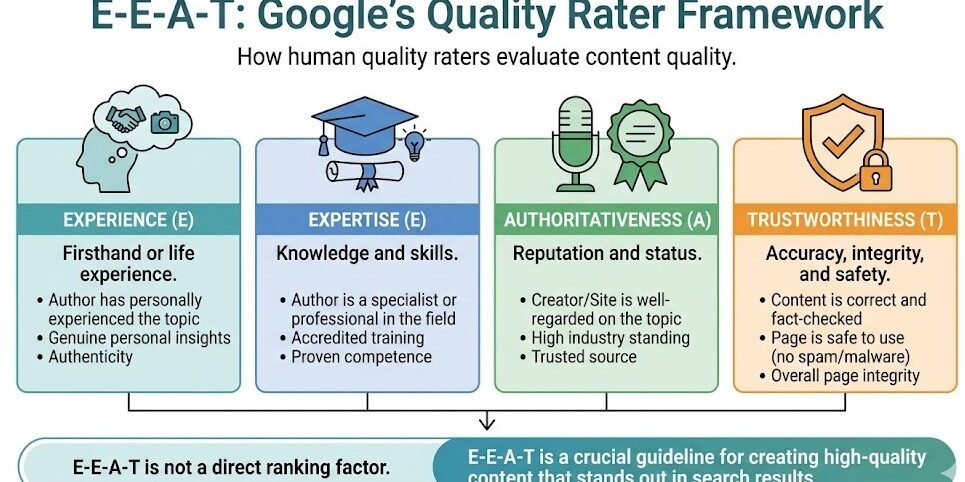
Practically, this means including your own experiences and opinions rather than just synthesizing what others have written. It means citing credible sources — studies, expert quotes, official data — rather than making unsupported claims. It means having a real author bio that establishes your credentials in the niche. And it means making sure your site has the basics: an About page, a clear contact method, a privacy policy, and a consistent publication history. These signals accumulate over time, and they’re one of the clearest differentiators between blogs that build lasting authority and ones that get shuffled down the rankings when Google’s next algorithm update rolls out.
| ⚠️ The AI Content Reality Check Google’s Helpful Content system doesn’t penalize AI-generated content specifically — it penalizes content that doesn’t genuinely help people. The problem with unedited AI output is that it tends to be comprehensive in coverage but shallow in insight. It summarizes well but rarely surprises, challenges, or genuinely teaches. That’s what you need to add in the editing phase. The blogs winning with AI assistance in 2026 are using AI to handle structure and first drafts, then layering in real perspective, specific examples, and human editorial judgment. The ones getting demoted are publishing AI output without any meaningful human contribution. |
Step 6: The AI & SEO Tools Worth Your Money in 2026
The AI tool landscape has exploded. There are hundreds of options, most of which are wrappers around the same underlying models with a pretty interface and a premium price tag. Below are the tools that have earned a place in a serious blogger’s workflow — not because they’re popular, but because they demonstrably improve output quality or save meaningful time.
AI Writing and Research
| Tool | What It Does Best | 2026 Pricing |
| Claude (Anthropic) | Long-form writing, editing, nuanced analysis, research synthesis | Free / Pro $20/mo |
| ChatGPT (OpenAI) | Ideation, drafts, structured outputs, coding, versatile all-rounder | Free / Plus $20/mo |
| Perplexity AI | Real-time research with citations — excellent for fact-gathering | Free / Pro $20/mo |
| Gemini Advanced | Deep Google integration, multimodal, strong for GSuite users | $19.99/mo |
| Jasper AI | Brand voice training, marketing copy, team collaboration | From $49/mo |
A note on which AI writing tool to use: Claude and ChatGPT are functionally similar for most blogging tasks, but Claude tends to produce longer, more nuanced prose and is better at maintaining a consistent voice across a long document. ChatGPT is more versatile for structured tasks, coding-adjacent work, and iterative back-and-forth. Perplexity is in a different category — it’s primarily a research tool, not a writing tool, and it’s worth using before you write rather than instead of writing.
SEO and Keyword Research
| Tool | What It Does Best | 2026 Pricing |
| Ahrefs | The gold standard for keyword research, backlink analysis, competitor gaps | From $99/mo |
| Semrush | All-in-one SEO suite, strong competitive intelligence, position tracking | From $117/mo |
| Surfer SEO | On-page optimization scoring against top-ranking competitors | From $79/mo |
| Rank Math SEO | WordPress plugin — on-page SEO, schema, redirects, sitemaps | Free / Pro $59/yr |
| KeySearch | Budget-friendly keyword tool — genuinely good for beginners | $17/mo |
| AlsoAsked | Maps out question-based keyword clusters visually | Free tier / Paid |
If budget is a constraint: start with Rank Math (free), KeySearch for keyword research, and the free tier of Google Search Console for performance data. That combination covers 80% of what you need in your first year. Upgrade to Ahrefs when you’re consistently publishing and need deeper competitive analysis.
Content Strategy and Optimization
| Tool | What It Does Best | 2026 Pricing |
| Frase.io | SERP analysis, AI-powered content briefs, optimization scoring | From $45/mo |
| Surfer SEO | Content editor with live optimization as you write | From $79/mo |
| MarketMuse | Topic modeling, content gaps, strategic content planning | Free / $99/mo+ |
| Notion AI | Content calendars, outlines, research notes — excellent UX | Free / Plus $10/mo |
| Grammarly | Grammar, clarity, tone — essential for polished final drafts | Free / Pro $12/mo |
| Hemingway App | Readability scoring, identifies over-complex sentences | Free web / $19 app |
Visuals and Design
| Tool | What It Does Best | 2026 Pricing |
| Canva AI | Blog graphics, infographics, social cards — fast and excellent | Free / Pro $13/mo |
| Midjourney | High-quality AI image generation for unique featured images | From $10/mo |
| Adobe Firefly | Professional AI image generation, integrated with Adobe CC | Included in CC plans |
| DALL-E 3 | Quick image generation, built into ChatGPT Plus | Included with Plus |
| Loom | Screen recordings and video walkthroughs for tutorial content | Free / Business $12/mo |
Step 7: On-Page SEO — What Still Matters, What Doesn’t
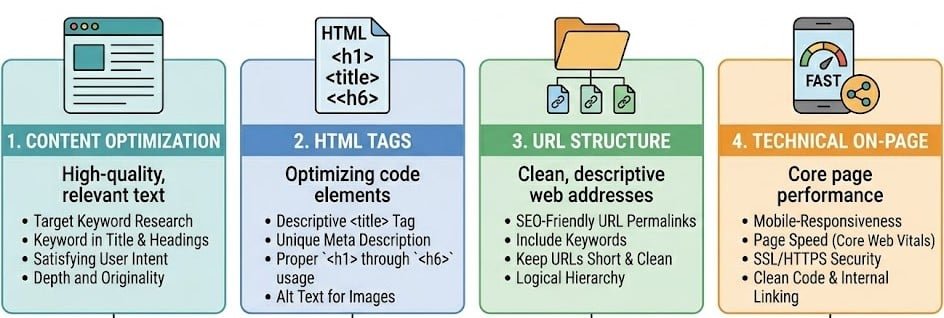
On-page SEO has a reputation for being either completely ignored by beginners or obsessed over to the point of paralysis. The truth is simpler: there are about eight things that genuinely matter, and most of them take less than 15 minutes per post to get right.
Title Tags and Meta Descriptions
Your title tag — what appears as the blue link in Google — should include your primary keyword as close to the beginning as possible, and stay under 60 characters to avoid truncation. The meta description (under 155 characters) doesn’t directly influence rankings, but it directly influences click-through rate, which does influence rankings over time. Write it like ad copy: one clear benefit, a reason to choose your result over the four others on the page.
URL Structure
Short, clean, keyword-containing URLs. Your URL for a post about intermittent fasting for beginners should be yourblog.com/intermittent-fasting-beginners — not yourblog.com/2026/05/01/a-complete-and-thorough-guide-to-intermittent-fasting-for-absolute-beginners-in-2026. Drop the date-based structure entirely unless you’re running a news site where recency is the primary value. Use hyphens, not underscores.
Image Optimization
Every image needs a descriptive file name (intermittent-fasting-meal-timing.jpg, not IMG_4723.jpg), an alt text that describes the image for screen readers and Google’s image index, and compression to minimize file size. WebP format is now the standard in 2026 — ShortPixel can convert and compress automatically. Never upload an image directly from your camera or phone without resizing it first; a 4MB JPEG from a smartphone will measurably slow your page.
Schema Markup
Schema is structured data that tells Google explicitly what type of content your page contains. Rank Math handles the basics automatically — Article, Author, and Breadcrumb schema — but you should also add FAQ schema manually to posts that include a frequently asked questions section. FAQ schema is one of the most reliable ways to earn expanded SERP real estate in 2026, and it takes about five minutes to implement with Rank Math.
Internal Linking
Internal linking is the most underrated on-page SEO practice. Every time you publish a new post, spend five minutes finding two or three older posts that are topically related and adding a link to the new post from each of them. This distributes link equity through your site, helps Google crawl new content faster, and keeps readers on your site longer. The anchor text you use for internal links matters — use descriptive, keyword-rich phrases rather than generic “click here” links.
Optimizing for AI Overviews
Google’s AI Overviews now appear at the top of the results for a large percentage of informational queries. Being featured in an AI Overview can drive significant traffic even if your page isn’t in the top organic position.
The patterns that correlate with AI Overview inclusion: direct, definitive answers to questions in the first paragraph of a section; structured content with clear H2 and H3 headings; strong E-E-A-T signals on the site overall; and content that matches the specific question’s framing closely. Think about how your content would read if someone asked Google a question out loud — and make sure your answer sounds like a direct, confident response.
Core Web Vitals — The Technical Floor
Google’s Core Web Vitals are the technical performance benchmarks that now factor into rankings. LCP (Largest Contentful Paint) should be under 2.5 seconds — this is primarily a hosting and image optimization issue. INP (Interaction to Next Paint) should be under 200 milliseconds — minimize JavaScript and avoid heavy third-party scripts. CLS (Cumulative Layout Shift) should be under 0.1 — always specify image dimensions so the browser doesn’t reflow the page while loading. Check your scores in Google Search Console under the Core Web Vitals report, and in PageSpeed Insights for per-page diagnosis.
Step 8: Promote Without Burning Out
The biggest myth in blogging is that great content promotes itself. It doesn’t. In a world where millions of pieces of content are published every day, publishing without distributing is essentially publishing into a void. That said, promotion doesn’t require you to be everywhere, posting constantly across every platform. That path leads to burnout and mediocre presence in too many places. Choose your distribution channels deliberately and do them well.
The One-Platform Depth Rule
Pick one social platform where your target audience actually lives and invest in building a real presence there before spreading to others. For personal finance, productivity, or career niches, that’s likely LinkedIn or Twitter/X. For lifestyle, food, or parenting, it’s Instagram or Pinterest. For younger or gaming-adjacent audiences, it’s TikTok or YouTube Shorts. The mistake is trying to maintain five platforms simultaneously with thin, recycled content. One platform done well will drive more traffic and faster audience growth than five done badly.
Content Repurposing with AI
Every long-form blog post you write contains the raw material for multiple formats. Ask Claude to take your 2,000-word guide and produce: a Twitter/X thread breaking down the key insights, a LinkedIn post framing it as a professional takeaway, an email newsletter version that’s more conversational and personal, and a short-form video script for TikTok or Reels. This isn’t lazy — it’s efficient. The same ideas, dressed appropriately for each format and each audience, multiply your reach without multiplying your workload.
Community and the Long Game
Before you have backlinks, before you have email subscribers, before Google trusts your domain — you have communities. Reddit, niche Facebook groups, Discord servers, and forums are full of people actively asking questions your content answers. The approach isn’t to spam links. It’s to become a genuine participant: answer questions thoroughly, build a reputation, and share your content when it’s directly relevant to someone’s specific question. This takes longer than a backlink campaign but builds something more durable: a community of people who trust you and share your work organically.
Link Building: The Part Nobody Likes Talking About
Backlinks remain one of the top three ranking signals, and they’re the hardest thing to acquire legitimately. The most effective approaches for a new blog in 2026: guest posting on established blogs in your niche (write one excellent guest post per month rather than churning out mediocre ones weekly), creating genuinely linkable content — original research, data compilations, comprehensive tools or templates that people want to reference — and reaching out to resource page curators in your niche who maintain lists of useful links.
AI helps with the outreach process. Use Claude to personalize outreach emails at scale — give it the recipient’s name, their publication’s focus, and your content’s specific value, and ask it to draft an email that doesn’t read like a template. Then edit it to sound like you. The quality of your outreach pitch matters more than the quantity of pitches you send.
Step 9: Build Your Email List from Post One
Here is the most important strategic advice in this guide, and the one most new bloggers ignore until it’s too late: your email list is the only audience you actually own. Social platforms change their algorithms, deprecate features, or ban accounts. Search rankings fluctuate with every algorithm update. Your email list is yours — no platform can take it from you.
Starting your list from day one costs you nothing but a few hours of setup, and even a small list of genuinely interested readers is worth more than thousands of casual social media followers. The bloggers who build seven-figure businesses consistently cite their email list as their primary asset.
Choosing Your Email Platform
| Tool | What It Does Best | 2026 Pricing |
| ConvertKit | Creator-focused, excellent automation, clean landing pages | Free to 1k / $29/mo+ |
| Beehiiv | Newsletter-first, built-in monetization, modern interface | Free / $49/mo |
| MailerLite | Best value for beginners — full features at low cost | Free to 1k / $9/mo |
| ActiveCampaign | Advanced automation, CRM integration, enterprise scale | From $29/mo |
The Lead Magnet — Your Growth Engine
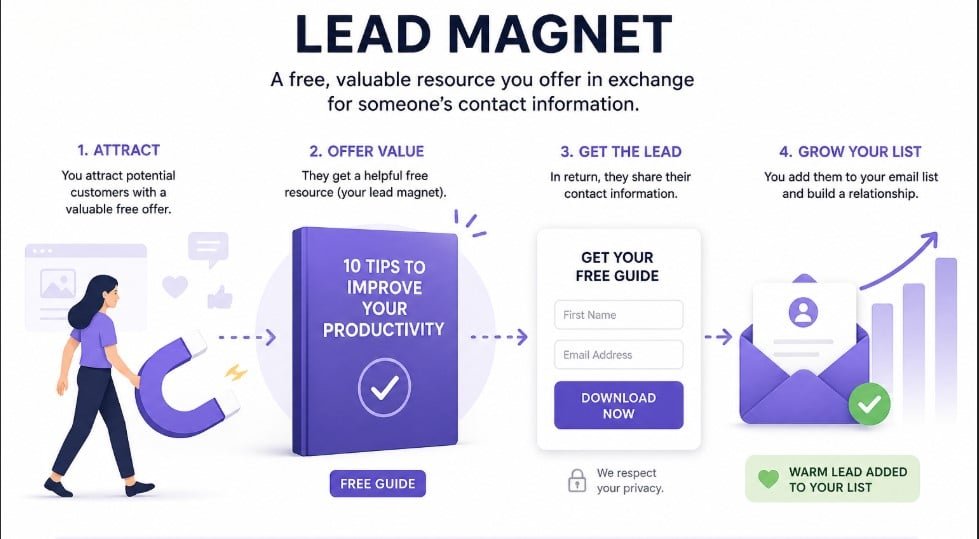
Nobody subscribes to a newsletter for the sake of it. They subscribe in exchange for something immediately useful. Your lead magnet is that something. It doesn’t need to be elaborate — in fact, the most effective lead magnets are highly specific and instantly actionable. A five-day email course on a specific problem your readers face. A one-page reference guide they’ll bookmark. A template that saves them an hour of work. A curated resource list they’d have spent a week finding themselves.
AI can produce the rough content of most lead magnets in a couple of hours. Ask Claude to draft a five-email course on a topic within your niche, then edit each email to add your voice and specific expertise. Design the final product in Canva — their templates make it fast to produce something that looks professional. The whole lead magnet creation process, done properly, takes a weekend. Many bloggers spend weeks on it; the difference is usually overthinking, not the actual work.
Place your signup form in three places: at the end of every post, in a sticky sidebar or header bar, and as a mid-content upgrade on your highest-traffic posts. Mid-content upgrades — offering a relevant bonus download in the middle of a post — consistently outperform bottom-of-post forms by a significant margin.
Step 10: Monetize Smartly — Timelines and Real Numbers
Let’s have an honest conversation about money. Most bloggers either try to monetize too early — before they have an audience, which results in minimal income and potential credibility damage — or wait too long, running out of motivation before they see any return. Getting the timing right matters.
The Realistic Timeline
In months one through three, your sole focus should be on content and SEO. Don’t run ads. Don’t aggressively promote affiliate products. You don’t have the traffic or authority to make meaningful income from either, and the presence of ads on a new site with few posts looks unprofessional to new visitors who are still deciding whether to trust you. Use this period to build the content foundation and establish topical authority.
From months four through six, start adding affiliate links naturally to content where specific products or services are genuinely relevant. Apply to display ad networks once you’re approaching 10,000 monthly sessions — Mediavine requires 50,000, Raptive 100,000, but some networks like Ezoic work with smaller sites. These won’t generate significant revenue yet, but they let you start learning about what converts.
Month seven onward is where strategic monetization becomes possible. By now you have enough content, enough traffic data, and enough understanding of your audience to make smarter decisions about which affiliate programs to prioritize, whether a digital product would sell, and whether your audience is large and engaged enough to approach sponsors. The bloggers who try to skip to this phase in month two are the ones who quit by month five.
The Monetization Channels That Actually Work
| Tool | What It Does Best | 2026 Pricing |
| Affiliate Marketing | Commission on referred product sales — 10% to 50%+ depending on niche | All niches |
| Display Advertising | Mediavine (50k sessions), Raptive (100k), Ezoic (smaller sites) | High-traffic blogs |
| Digital Products | Ebooks, templates, Notion systems, courses — high margins | Any niche |
| Coaching / Consulting | 1:1 or group sessions — high revenue per client | Expert-led niches |
| Sponsored Content | Brand partnerships and product reviews — requires audience trust | Lifestyle, tech, finance |
| Newsletter Sponsorships | Charge brands to reach your email list — scales with list size | Any niche with a list |
Affiliate marketing deserves extra attention because it’s the most accessible for new blogs and can scale significantly. The key is picking affiliate programs where you genuinely believe in the product, where the commission structure is meaningful (many SaaS affiliate programs pay 20 to 40% recurring commissions), and where the product is something your audience would logically buy. A fitness blog promoting a specific protein powder brand they actually use converts far better than one promoting every supplement under the sun.
AI’s Role in Monetization

AI accelerates the monetization side of blogging in ways that are genuinely powerful. You can use it to write product review drafts that you then edit with your real experience, to create comparison articles that genuinely help readers choose between products, to draft email sequences for your digital product launches, and to generate outreach pitches to brands for sponsorship deals. The time savings are substantial — a sponsorship pitch that might take you an hour to write from scratch takes ten minutes with AI assistance.
Step 11: Measure, Iterate, and Compound Your Growth
The bloggers who build lasting success aren’t the ones who publish the most. They’re the ones who pay attention to what’s working and keep doing more of it, and who identify what’s not working and fix it before it becomes a systemic problem. This requires a measurement practice — not an obsessive one, but a consistent one.
The Metrics That Actually Matter
There are dozens of metrics you could track, and most of them are noise. The ones that actually correlate with growth are organic traffic sessions (from Google Search Console), average position for your target keywords (also Search Console), email subscriber growth rate, and revenue per thousand visitors. Everything else is a vanity metric until your site reaches significant scale.
Set up Google Analytics 4 and Google Search Console on day one — both are free and take about 20 minutes to configure. In Search Console, the Performance report shows exactly which queries are driving impressions and clicks to each of your pages. This is the most valuable data you have access to as a blogger, and most people barely look at it.
The Content Update Strategy
One of the highest-ROI activities for a growing blog is updating existing content rather than constantly publishing new pieces. Search Console will show you posts that are ranking on page two — positions 11 through 20. These posts are what SEOs call “striking distance” opportunities: they’ve already established enough authority to be relevant, but need improvement to break through to page one.
The update process is methodical. Read the post as if you’d never seen it. Compare it against the current top-ranking results for the same keyword — what are they covering that you missed? What’s changed since you wrote the original? Add new sections where the content is thin, update any statistics or references that are outdated, improve the internal linking to and from the post, and refresh the meta description. A well-executed content update on a striking-distance post can move it from position 14 to position 4 in three to six weeks. Do this systematically every month and the compounding effect is significant.
When to Pivot vs. When to Persist
The hardest skill in blogging is distinguishing between a strategy that needs more time and a strategy that’s genuinely not working. A reasonable rule of thumb: if you’ve published 30 or more posts with consistent quality and SEO intention, and six months in you’re getting fewer than 500 organic visits per month, something is wrong. Usually it’s one of three things: the niche is too competitive for a new site, the keyword targeting is off (too competitive or too little volume), or the content quality isn’t good enough to compete with what’s currently ranking. Each of these has a specific fix, and identifying which one applies to you is worth a dedicated analysis session.
Step 12: The Mistakes That Kill Blogs — And How to Dodge Them
Every mistake in this section is one that real bloggers have made repeatedly. They’re worth enumerating explicitly because they’re not obvious in advance and because each one has derailed promising blogs that had everything else going for them.
Targeting Competitive Keywords Too Early
A new blog targeting “best credit cards” or “how to lose weight” is competing against domains with thousands of backlinks, decade-long authority, and full-time editorial teams. You will not rank for those terms in your first year, and possibly not in your first three years. This isn’t pessimism — it’s the reality of how domain authority accrues. Target long-tail keywords with lower difficulty while you build authority, and treat each one you rank for as a stepping stone toward higher-competition terms. The bloggers who succeed are the ones who play the long game with realistic targets.
Publishing and Doing Nothing Else
Publishing a post and waiting for Google to find it is a passive strategy in a world that rewards active distribution. Submit your sitemap to Google Search Console immediately after launch. Build your first few backlinks — even if it’s just being active in communities and occasionally referencing your work — within the first month. Share each post at least once across your chosen platform. These actions matter most in the early months when Google is still deciding how much to trust your domain.
Redesigning Instead of Writing
There is a specific kind of procrastination that afflicts bloggers, and it looks exactly like productivity. It’s spending three weeks redesigning the blog instead of publishing. Tweaking the logo instead of finishing the post. Testing new themes instead of building backlinks. Your design needs to be functional, fast, and not actively ugly. Beyond that, it does not move the needle. Traffic comes from content and backlinks, full stop. Every hour spent on design is an hour not spent on the things that actually drive growth.
Ignoring the Email List
Every month you delay building your email list is a month of potential subscribers lost permanently. The people who visit your blog today and find it genuinely useful are your best potential subscribers — and if you don’t capture them now, they’ll move on and likely never return. Set up your email platform and a simple lead magnet before you publish your first post if possible, or immediately after. A list of 200 engaged subscribers is more valuable than 2,000 social media followers who’ll never see your posts again.
The Six-Month Wall
Most blogs that fail don’t fail because of bad strategy or poor content. They fail because the person running them quit between months three and six, when traffic is low, income is near zero, and the initial excitement has worn off. This period is genuinely difficult, and it’s made worse by the fact that the progress happening during it is largely invisible — you’re building topical authority, accruing backlinks, earning crawl trust from Google — none of which shows up dramatically in your analytics on a day-to-day basis.
The practical way through this period is to set process goals rather than outcome goals. Instead of “get 10,000 monthly visitors” (which you cannot directly control), commit to “publish two posts per week and build two backlinks per month.” Process goals are achievable regardless of where your traffic is, and consistent execution of the right processes is what drives traffic over time. Every blogger who has a successful site went through this period. The ones with successful sites are the ones who didn’t stop.
| One Final Thought Blogging is not easier than it was five years ago — it’s different. AI has removed the execution bottleneck but raised the floor on content quality. The bloggers who thrive are the ones who understand that AI is a tool for thinking and writing faster, not a replacement for having something genuinely worth saying. Your advantage over the mass of AI-generated content flooding the internet is precisely what no AI can replicate: your specific experience, your real opinions, your genuine relationship with your audience. Lean into that. Use the tools in this guide to publish faster and smarter — but never let them replace the human voice that makes your blog worth reading. Your audience is out there, actively searching for what you know. Go write it for them. |
Found this guide valuable?
Share it with someone who has been sitting on a blog idea for too long. Sometimes one good guide is all the push someone needs.