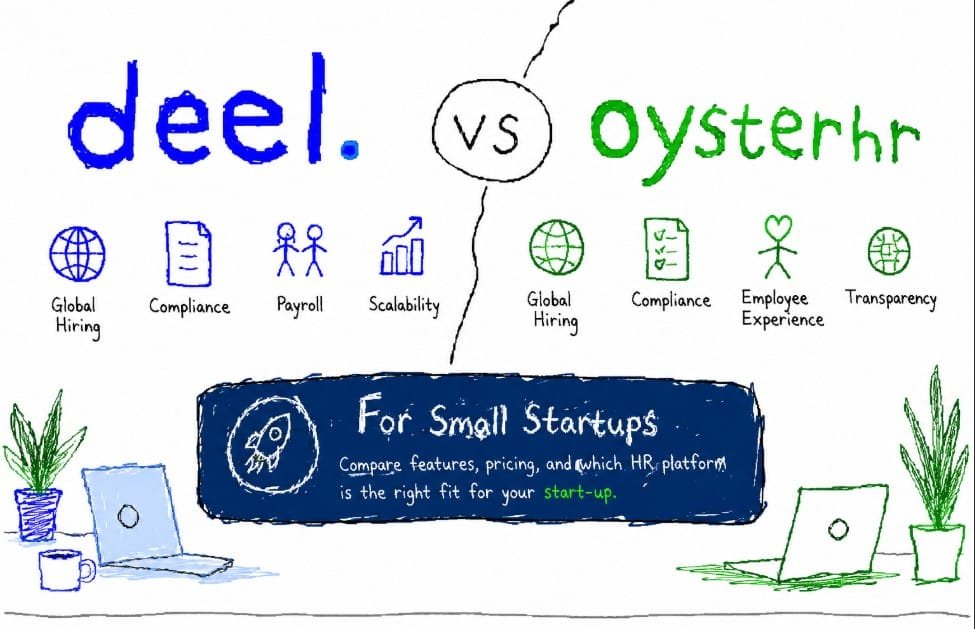
You’ve got maybe 8, 12, or 15 people. Some are contractors, a couple are full-time employees in different countries, and you’re trying to figure out how to pay everyone correctly, stay compliant, and not spend your entire morning dealing with payroll admin.
Enter the alphabet soup of modern HR tech: Deel, Oyster HR, Remote, Rippling, Gusto. Everyone on LinkedIn has an opinion. Most blog posts are either thinly veiled affiliate spam or so high-level they’re useless.
This one tries to be different. I’ve worked with multiple early-stage SaaS companies navigating this exact decision, and I want to give you the honest view — including where each platform falls short, what the pricing actually looks like in practice, and why I tend to recommend Deel for most sub-20 teams (though it’s not the right fit for everyone).
Let’s get into it.
| ⚠️ Transparency note: I’m an affiliate , which means I earn a commission if you sign up through my links. That said, everything below reflects genuine experience and research — I’ll be clear about tools limitations too. |
1. What Are These Platforms Actually For?
Before comparing them, it’s worth being precise about the problem they solve — because Deel and Oyster HR are both targeting the same pain point but approach it slightly differently.
The core problem: You want to hire someone in another country. You don’t have a legal entity there. You need a way to do it legally, handle taxes, and run payroll without setting up a local subsidiary, which is expensive and slow.
The solution is called an Employer of Record (EOR). You pay a monthly fee to a platform that legally employs your team member on your behalf in their country, handles local compliance, benefits, and payroll taxes, and passes the cost on to you.
Both Deel and Oyster HR do this. They also both handle independent contractor payments globally. The differences are in pricing structure, user experience, the depth of their integrations, how they handle edge cases, and how well they scale beyond HR into broader business tooling.
Related : Deel vs Remote vs Rippling: Best EOR for Scaling Agencies
2. Pricing: What You’ll Actually Pay
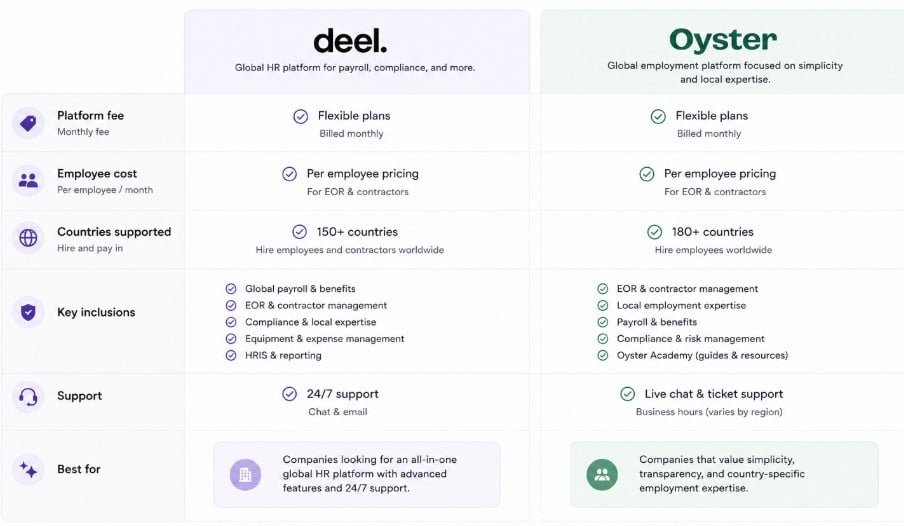
Deel Pricing
Deel’s pricing has evolved quite a bit. For small teams, here’s the breakdown as of 2025:
- EOR (Employer of Record): $599/month per employee. This covers full employment in 150+ countries including payroll, compliance, and local benefits.
- Contractor management: Free for the contractor-side features; $49/month per contractor for compliance tools and localized contracts.
- Deel HR (core HRIS): Free for teams under 200 people. This is a relatively new addition and genuinely useful — it includes org chart, time-off tracking, onboarding flows, and document storage.
- Deel Payroll (US): $19/month per employee for US-based payroll.
Oyster HR Pricing
For a startup with, say, 5 full-time EOR employees and 3 contractors, you’re looking at roughly $3,000–$3,200/month on Deel. That’s not cheap in absolute terms, but it’s a fraction of what it would cost to set up entities in each country.
Oyster HR has a cleaner, more entry-level-friendly pricing structure on the surface:
- EOR: Starting around $499–$699/month per employee depending on country (some countries carry a premium). Oyster is competitive with Deel here.
- Contractor: $29/month per contractor for full management features, or free for basic payment-only use.
- Scale plan: Custom pricing for teams with more complex needs.
Oyster has occasionally run discounts and promotions for early-stage startups, and their UI is genuinely polished and pleasant to use. The pricing feels slightly more startup-friendly at first glance, but the gap narrows when you factor in what’s included.
Side-by-Side Pricing Snapshot
| Feature | Deel | Oyster HR |
| EOR per employee/mo | $599 | $499–$699* |
| Contractor management | $49/contractor | $29/contractor |
| Core HRIS | Free (up to 200) | Included in plan |
| US Payroll | $19/employee | Not standalone |
| Free trial / demo | Yes | Yes |
| Startup discounts | Available | Available |
*Oyster country pricing varies. Some regions carry a premium above the base rate.
| 💡 Bottom line on pricing: For a small team running a mix of contractors and EOR employees, the cost difference between Deel and Oyster is often less than $100–200/month. The decision shouldn’t hinge purely on pricing — it should hinge on which platform will save you more time and grow with your company. |
3. Hiring and Onboarding Experience
This is where things get more opinionated, so let me share what I’ve seen in practice.
Deel’s Onboarding Flow
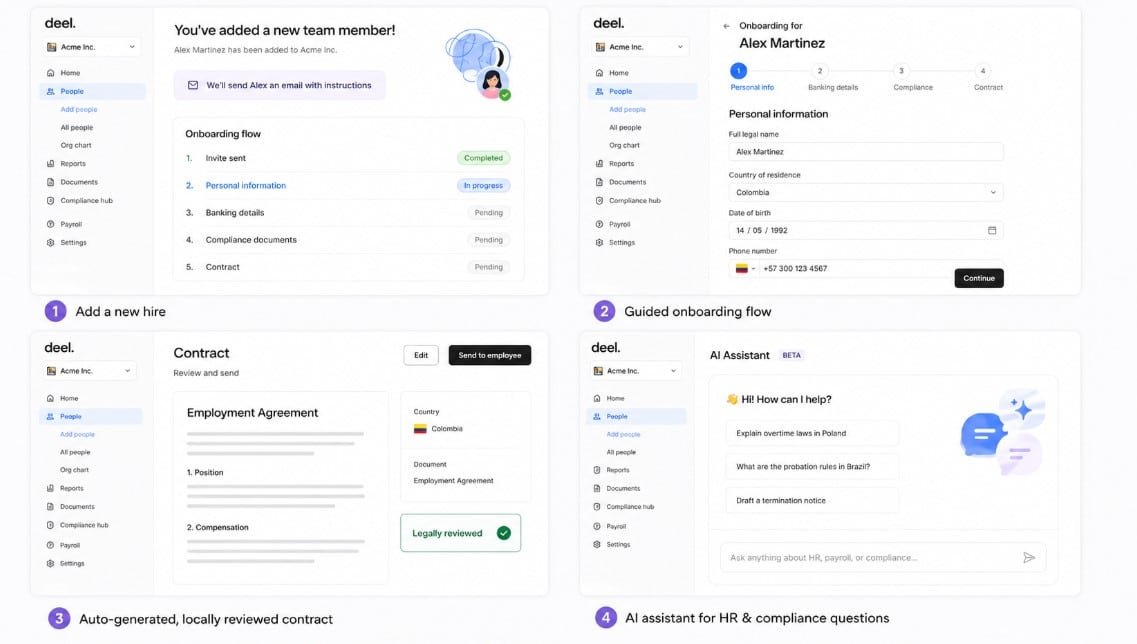
Deel’s onboarding for new hires is genuinely fast. Once you’ve set up an employee in the system, they get a guided experience to submit their personal information, banking details, and local compliance documents. Deel handles the employment contract generation automatically, localized to the country.
What stands out: Deel’s contract generation is highly automated and legally reviewed for 150+ countries. For a founder who’s never hired in Colombia or Poland before, having a contract auto-generated that you know has been reviewed by local legal experts is genuinely reassuring.
Deel also recently added an AI assistant inside the dashboard that can answer HR policy questions, explain local labor laws, and help draft communications to employees. It’s a small feature, but for a team without a dedicated HR person, it’s the kind of thing that saves real time.
Oyster HR’s Onboarding Flow
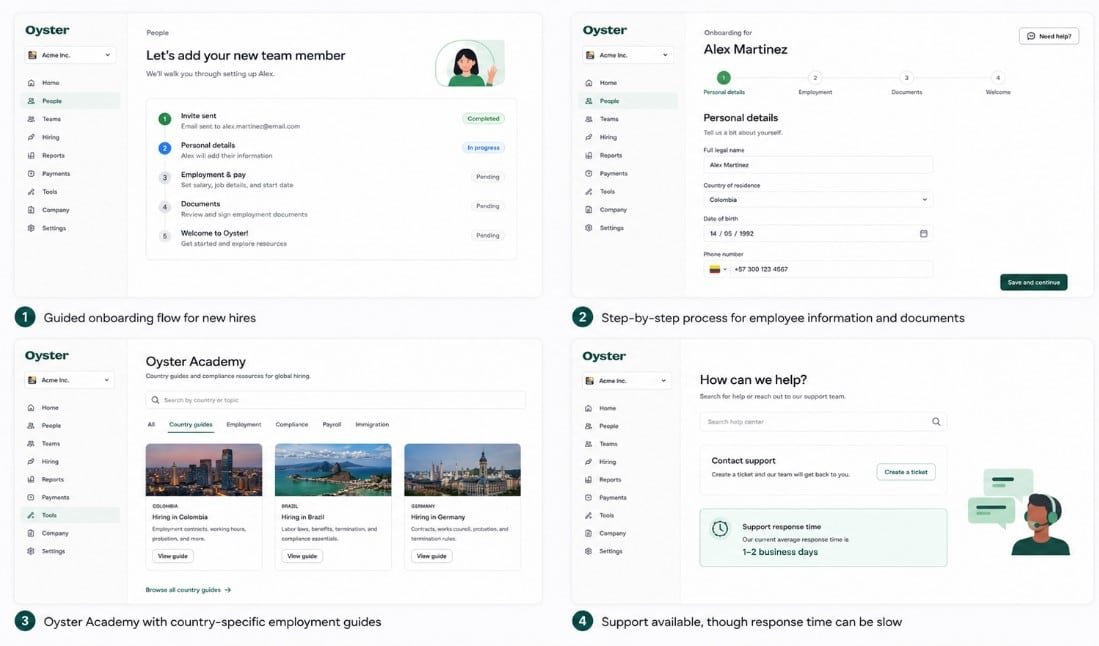
Oyster’s onboarding is clean and guided, with a strong focus on the employee experience. One thing Oyster does well is its ‘Oyster Academy’ — a repository of country-specific employment guides and compliance information that’s genuinely useful for first-time international hirers.
Their dashboard has a more modern aesthetic feel, and new employees report the onboarding portal feels approachable. That said, I’ve heard from a few founders that Oyster’s support response time during the onboarding phase could be slow, particularly for countries with more complex compliance requirements.
4. Contractor Management (This Matters More Than You Think)
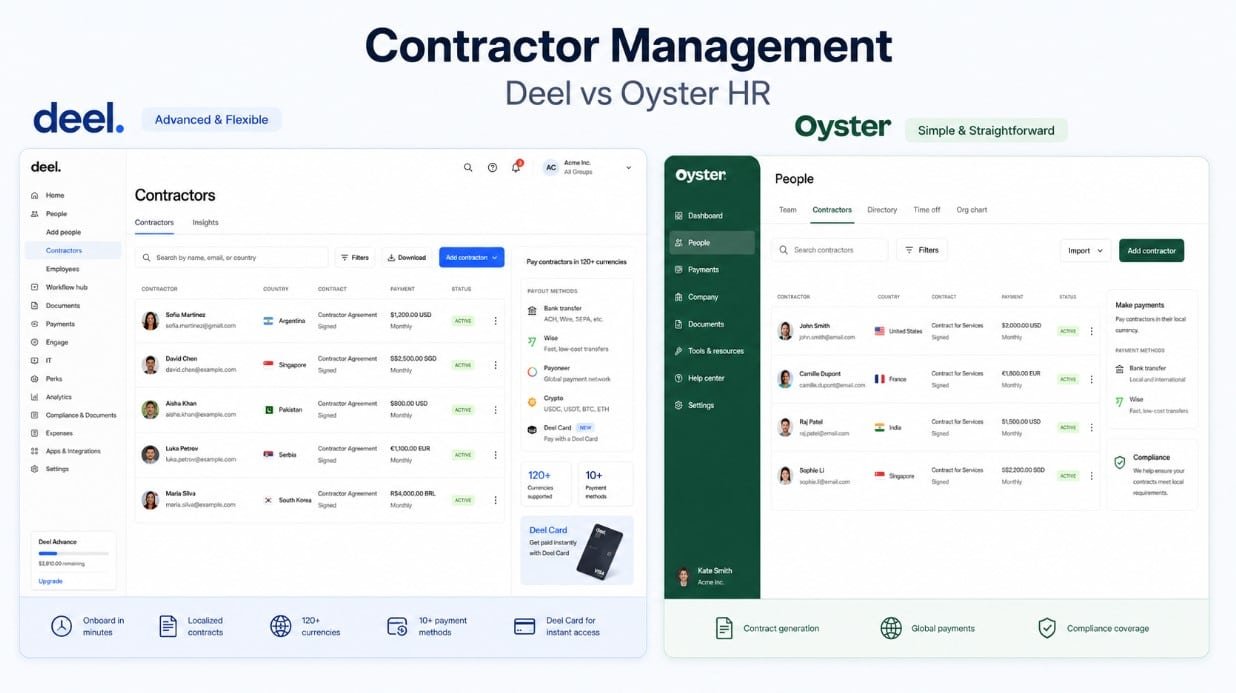
Most sub-20-person startups aren’t running a pure EOR setup. They have a mix: a couple of full-time employees, several contractors in different countries, maybe a few US-based W2s. Contractor management is often the bigger daily workflow.
Deel’s contractor module is one of the best in the market. You can onboard a contractor in minutes, generate a localized contract, and pay them in their preferred currency. The platform supports 120+ currencies and 10+ payment methods including direct bank transfer, Wise, Payoneer, crypto, and Deel’s own Deel Card (a prepaid card that contractors can use for immediate access to their funds).
The Deel Card feature is something Oyster doesn’t offer. For contractors who want instant access to earnings without waiting for a bank transfer, it’s genuinely useful — and it differentiates Deel in markets where local banking is slower or less reliable.
Oyster’s contractor management is solid but more basic. It covers payments, contract generation, and basic compliance checking. If your contractor workflow is straightforward, you may not notice the gap. But if you’re paying contractors in 15 different countries with different currency preferences, Deel handles the complexity more gracefully.
5. Integrations and Productivity Stack
Here’s a topic most comparison articles skip: how these platforms fit into your actual productivity and tooling stack.
Does Google Workspace Make Sense for a Sub-20-Person Team?
Short answer: yes, probably. Here’s why — and why it matters in the context of Deel vs Oyster.
Google Workspace (formerly G Suite) gives your team professional email (@yourcompany.com), shared Drive storage, Docs/Sheets collaboration, Meet for video calls, and Calendar. For a team under 20 people, the Business Starter plan runs about $6/user/month — so $120/month for 20 people.
Compared to what you’d cobble together with free tools, the unified admin panel, the shared file organization, and the professional email alone justify the cost. More importantly, both Deel and Oyster integrate with Google Workspace for directory sync, which means your new hire’s account can be provisioned automatically when they’re onboarded in your EOR platform.
Deel’s integration library is notably broader. Deel has native integrations with:
- Google Workspace (directory sync, SSO)
- Slack (notifications, approvals)
- Notion, Linear, Jira (onboarding task automation)
- QuickBooks, Xero, Netsuite (payroll data sync)
- Greenhouse, Ashby, Lever (ATS integrations)
- BambooHR, HiBob, Workday (HRIS data sync)
Oyster’s integrations are more limited, especially on the ATS and financial tooling side. If you’re using Ashby or Greenhouse for recruiting and QuickBooks for accounting, Deel’s native connectors will save you hours of manual data entry per month.
| 📌 For a startup using Slack, Google Workspace, and any modern accounting tool, Deel’s integration depth is a meaningful operational advantage. Oyster is catching up, but the gap is real. |
6. Compliance and Legal Coverage
Both platforms provide legally compliant employment contracts and payroll in their supported countries. This is table stakes — if they didn’t, they wouldn’t be in business. But there are differences worth noting.
Country Coverage
Deel supports employment in 150+ countries. Oyster supports around 130+. For most startups, this doesn’t matter — you’re hiring in 3–8 countries, and both platforms cover the major markets.
The gap shows up in less common markets. If you need to hire in a frontier market — think Kazakhstan, Bolivia, or Mozambique — Deel is more likely to have direct coverage. Oyster sometimes works through third-party EOR partners in less common markets, which can introduce variability in the quality of support.
Misclassification Protection
This is big. Classifying someone as a contractor when they should legally be an employee is a major compliance risk in many countries. Deel has a built-in misclassification assessment tool that flags risk based on the working relationship you describe. Oyster has similar functionality but it’s less prominent in the workflow.
For a small startup whose founders are not HR experts, having this automated guardrail is genuinely valuable.
7. Where Deel Falls Short
I said I’d be honest, so here’s where Deel isn’t the right answer:
- Pricing for very early teams: If you have one EOR employee and you’re truly bootstrapped, $599/month is a real cost. Oyster’s slightly lower entry pricing and willingness to negotiate for early-stage startups can make a difference.
- Complexity for simple use cases: Deel’s dashboard has a lot of features. For a 5-person team paying 3 contractors in the same country, the platform can feel like overkill. Oyster’s cleaner UI might be less overwhelming.
- Customer support variability: Deel’s support is generally responsive, but like any platform at scale, there are reports of slower response times for complex edge cases. This has improved significantly but isn’t perfect.
- Recent product changes: Deel has been expanding rapidly — acquiring companies, adding features, rebranding product lines. For a startup that wants a stable, simple tool, the pace of change can occasionally feel disorienting.
8. Where Oyster HR Falls Short
In fairness, here’s where Oyster struggles:
- Integration depth: As mentioned, Oyster’s third-party integration library is narrower. If your ops stack is beyond the basics, you’ll feel this.
- Contractor payment flexibility: Oyster doesn’t offer the payment method variety that Deel does. No Deel Card equivalent, fewer currency options.
- HRIS functionality: Oyster’s HRIS features are more basic compared to Deel HR’s free offering. For a small team, this may not matter — but if you want org charts, time-off policies, and onboarding workflows in one place, Deel HR gives you that at no extra cost.
- Speed of iteration: Oyster has been slower to ship new features compared to Deel. This isn’t a dealbreaker, but in a fast-moving space, it’s worth noting.
9. The Google Workspace Question — Actually Worth It?
Since this comes up a lot: yes, Google Workspace is worth it for most startups under 20 people, but here’s the nuance.
When to pay for it: You’re customer-facing. You want professional email. You need collaborative document management. Your team is remote and distributed. You want admin controls over accounts when employees leave.
When to skip it: You’re literally pre-revenue, building in stealth, and cost is a genuine constraint. In that case, use personal Gmail for now and migrate later. It’s not hard to switch.
The $6–12/user/month cost is trivially small compared to your EOR costs. And both Deel and Oyster will sync more cleanly with a proper Google Workspace directory than with a pile of individual Gmail accounts. From an ops hygiene perspective, set it up early — it’s one of those decisions that’s much easier to make proactively than to clean up after the fact.
10. Which Platform Should You Choose?
Here’s my honest recommendation matrix — based on the type of company you are, not a generic answer.
| Choose Deel if… | Choose Oyster if… |
| You’re paying contractors in 10+ countries with varied payment preferences | You’re hiring 1–2 EOR employees and want the simplest possible experience |
| You use Slack, Google Workspace, Ashby/Greenhouse, and QuickBooks | Your tooling stack is minimal and integration depth isn’t a priority |
| You want HRIS, payroll, and contractor management in one platform | You want a slightly lower entry price and a cleaner, less feature-heavy UI |
| You anticipate growing beyond 20 people in the next 12 months | You’re hiring only in countries where Oyster has strong direct presence |
| You want built-in misclassification protection and compliance tools | You’re very early stage and every $100/month matters |
The honest summary: for most startups under 20 people who are building internationally distributed teams and want a platform that grows with them, Deel is the stronger long-term choice. The free Deel HR tier alone eliminates the need for a separate HRIS tool. The integration depth saves operational time as you grow. And the contractor payment flexibility is genuinely superior.
That said, if you’re at the very earliest stage — 2–3 hires, simple use case, cost-sensitive — Oyster is a perfectly good platform and there’s no shame in starting there and migrating later if you need to.
Conclusion: Don’t Over-Engineer This Decision
The EOR space has matured a lot. Both Deel and Oyster HR are legitimate, well-funded companies with real compliance infrastructure. You’re not going to make a catastrophically wrong choice between them.
What matters more than picking the ‘best’ platform is picking one and setting it up properly from the start — clean contracts, proper classification, consistent payroll timing, and a tooling stack that doesn’t require manual data entry to hold it together.
For most sub-20-person startups building internationally, Deel checks more boxes: better integrations, broader contractor payment options, a free HRIS layer, and a platform built to scale beyond the early stage.
For the simplest use cases or the most cost-sensitive situations, Oyster HR is a solid choice with a genuinely pleasant UX.
Either way, don’t let the HR platform decision slow down hiring. Get the system in place, automate what you can, and put your attention back on the product.
FAQ: Deel vs Oyster HR for Small Teams
Is Deel or Oyster HR better for a startup with fewer than 10 employees?
For a team under 10, both platforms work, but Deel’s free HRIS tier and stronger contractor payment options make it a better foundation if you plan to grow. If you have a single EOR employee and a very tight budget, Oyster’s entry-level pricing can be slightly friendlier.
Can I use both platforms at the same time?
Technically yes, but it’s operationally messy and rarely worth it. Pick one and standardize. The slight pricing advantages of mixing platforms don’t outweigh the admin overhead of managing two systems.
Does Deel integrate with Google Workspace?
Yes. Deel has native Google Workspace integration for directory sync and SSO. When you onboard a new hire in Deel, you can provision their Google Workspace account automatically. Oyster also has Google Workspace integration, but it’s less feature-complete.
Is Google Workspace actually necessary for a small remote team?
Not strictly necessary, but highly recommended. Professional email, collaborative document management, and admin controls over user accounts are worth $6–12/user/month. Both Deel and Oyster integrate more cleanly with a Google Workspace directory than with personal email accounts.
How does Deel’s pricing compare to Oyster for EOR employees?
Both platforms charge roughly $499–$599 per EOR employee per month depending on country. The bigger differentiator is what’s included: Deel’s free HRIS, broader contractor payment options, and integration depth often make its all-in cost lower when you account for what you’d otherwise pay for separate tools.
What’s the risk of getting EOR wrong?
Significant. Misclassifying employees as contractors, failing to comply with local labor law, or paying incorrectly can result in fines, back taxes, and employment disputes. Both Deel and Oyster have legal teams and compliance infrastructure to handle this — which is exactly why using either platform is better than trying to DIY international hiring.
Does Deel work for US domestic payroll too?
Yes. Deel has US payroll at $19/employee/month for W2 employees. If you’re running a hybrid team with some US employees and some international, Deel can handle the whole stack in one platform. Oyster does not have a comparable standalone US payroll offering.