You’ve outgrown the freelancer model. Your agency is winning bigger retainers, your team is stretched, and you’ve found the right talent — except they’re in Colombia, the Philippines, or Portugal. Now you need to hire them properly without setting up a foreign entity, without a six-month legal process, and without adding another nightmare to your operations stack.
That’s exactly what Employer of Record (EOR) platforms are built for. You handle the strategy. The EOR handles the local employment contracts, tax filings, payroll, benefits, and compliance in every country where your team lives.
The three names that come up constantly in this space are Deel, Remote, and Rippling. They’re all credible. They’re all used by real companies. But they are not the same product, and for a growing agency, choosing the wrong one will cost you time, money, and friction you can’t afford.
This comparison cuts through the marketing to tell you what each platform actually delivers for agency operators who need to move fast, hire globally, and keep overhead manageable. By the end, you’ll know which one fits where you are right now — and where you’re headed.
Deel vs Remote vs Rippling
What Is an Employer of Record — and Why Do Agencies Need One?
An EOR is a third-party company that legally employs workers on your behalf in countries where you have no business entity. They become the employer on paper, handling local labor law compliance, payroll tax obligations, statutory benefits, and employment contracts. You direct the work. They handle the legal and administrative scaffolding.
For agencies, this matters for a specific set of reasons that go beyond what most general EOR comparisons cover:
- Agencies scale headcount quickly based on client wins — and have to downscale just as fast when scopes change.
- Creative and technical talent is globally distributed. The best motion designer for your team might be in Buenos Aires. The best developer might be in Krakow.
- Agency margins are tight. Paying $30,000+ to set up a foreign entity for one hire in a market you’re not sure about is not a viable option.
- Compliance risk is real. Misclassifying contractors as employees — or vice versa — exposes you to penalties that can eclipse an entire year’s profit.
An EOR solves all of this. The real question is which EOR solves it best for your specific situation as an agency.
The Three Platforms: A Quick Overview
Deel
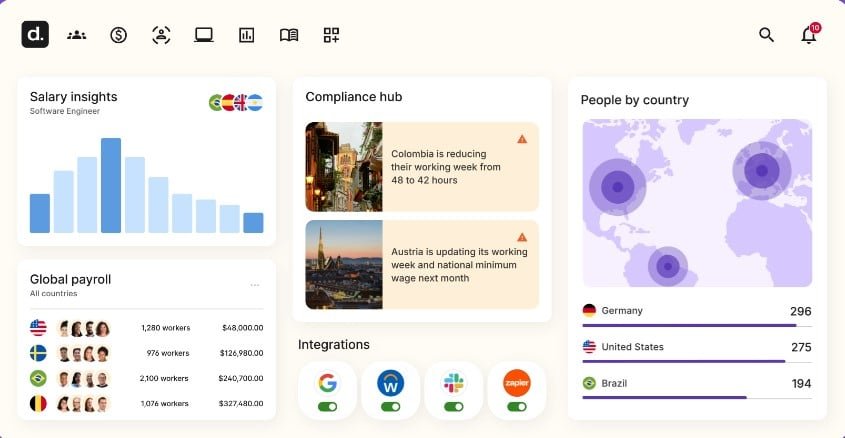
Founded in 2019, Deel became one of the fastest-growing HR tech companies in history. It started with a contractor management product and has expanded into a full global people platform covering EOR employment, contractor payments, payroll, immigration support, equity management, and HRIS. As of 2024, Deel operates in 150+ countries and has processed payroll for hundreds of thousands of workers globally.
The core proposition: Deel lets you hire anyone, anywhere, compliantly, with a product experience that’s actually intuitive enough that your ops team won’t hate using it.
Related : Why Smart Teams Are Quietly Switching to Deel (deel review)
Remote
Remote launched in 2019 as well, positioning itself specifically around helping companies hire full-time employees internationally. It built its own local entities in dozens of countries (rather than relying on a network of third-party partners), which is a structural differentiator they market heavily around compliance reliability.
The core proposition: Remote prioritizes the legal infrastructure behind EOR, with a focus on clean, compliant hiring and a transparent approach to what they own vs. partner for.
Rippling
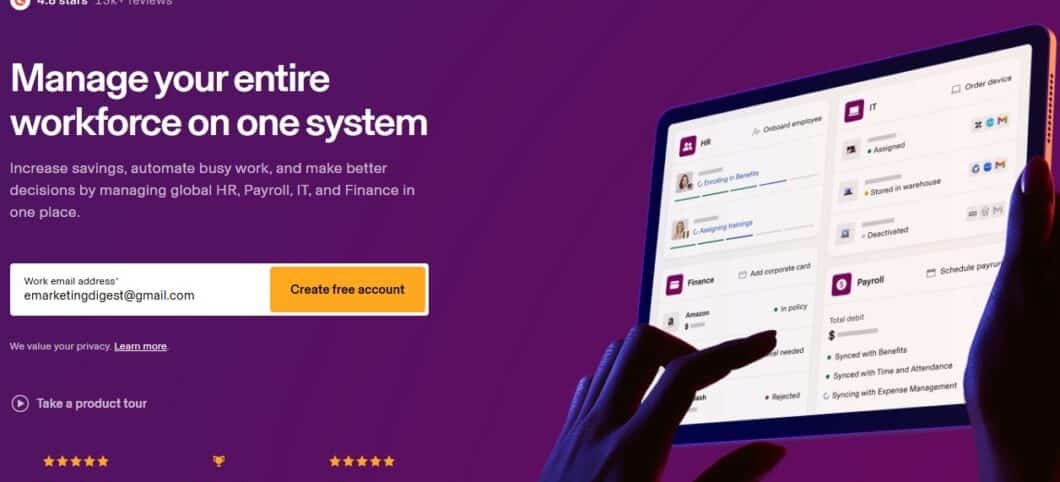
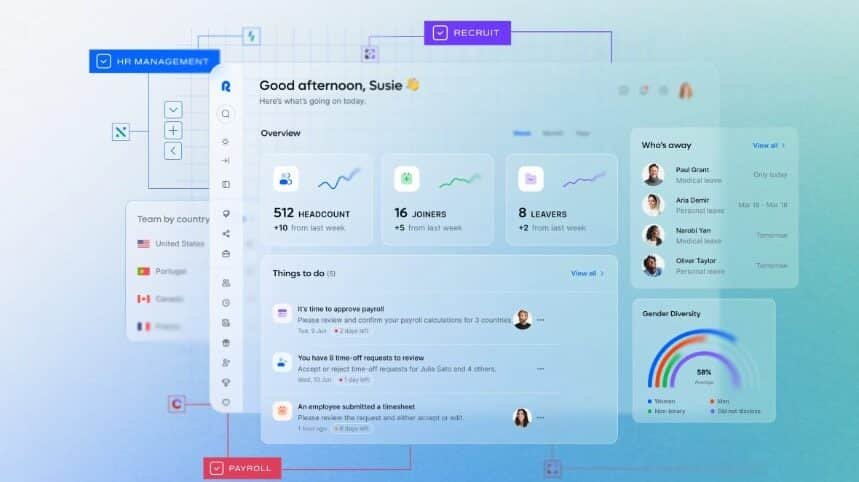
Rippling is a different beast. It’s fundamentally a workforce management platform that unifies HR, IT, and finance systems — with EOR capabilities added on. It’s built around the idea that all your employee data should live in one system, and that system should trigger every downstream workflow: device provisioning, app access, payroll, benefits, and offboarding.
The core proposition: Rippling is for companies that want deep operational integration across HR, IT, and finance. EOR is one module in a broader system.
Deel vs. Remote vs. Rippling: Feature Comparison at a Glance
Choosing the right Employer of Record (EOR) often comes down to where you are hiring and how much of the “back office” you want to automate. While Deel, Remote, and Rippling all handle global hiring and payroll, they lean into different strengths—ranging from pure geographic reach to deep IT integration.
The following table breaks down the core features, compliance depth, and ideal use cases for each platform to help you decide which fits your current growth stage.
| Feature | Deel | Remote | Rippling |
| EOR Coverage | 150+ countries | 75+ countries | 50+ countries |
| Contractor Management | Yes – core product | Yes – basic | Yes – module add-on |
| Owned Legal Entities | Mix of owned + partners | Primarily owned | Partner network |
| Payroll (Global) | Yes | Yes | Yes (US-native strength) |
| HRIS / HR System | Built-in | Built-in | Full-platform HRIS |
| IT Provisioning | No | No | Yes – flagship feature |
| Immigration Support | Yes | Partial | No |
| Equity / Stock Options | Yes | No | Yes |
| Compliance Monitoring | Yes – real-time alerts | Yes | Yes |
| Dedicated Support | Yes – local legal experts | Yes – compliance team | Yes – enterprise tier |
| API & Integrations | Extensive | Good | Extensive |
| Best For | Fast-growth agencies, global teams | Compliance-first companies | US-HQ companies scaling ops |
Pricing and Value: What You Actually Pay
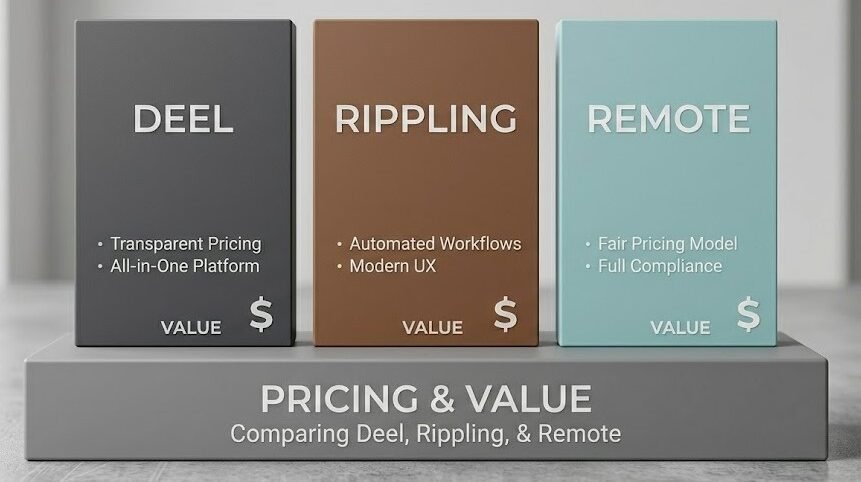
Pricing in the EOR world is murky. Vendors are reluctant to publish hard numbers because costs vary by country, employment type, and scope. That said, here’s an honest breakdown of how the three platforms compare based on publicly available information and industry-standard pricing tiers.
Deel Pricing
Deel’s EOR pricing typically starts around $599 per employee per month, with costs varying by country. Contractor management through Deel starts at $49 per contractor per month, which is particularly relevant for agencies that rely on a mix of full-time and project-based workers. Deel also offers a free HRIS tier for companies managing their own payroll, which is genuinely useful as an entry point.
The contractor product is where Deel has historically been most cost-competitive, and for agencies that use a blend of contractors and full-time international hires, this flexibility in a single platform represents real savings in software spend and operational complexity.
Remote Pricing
Remote’s EOR pricing starts at approximately $599 per employee per month for annual plans, with slightly higher month-to-month rates. Their contractor management product starts at around $29 per contractor per month, making it one of the more affordable options on that specific use case.
Remote has built a reputation for pricing transparency, with fewer hidden fees around setup or offboarding than some competitors. For agencies that value predictability in their finance models, that clarity matters.
Rippling Pricing
Rippling’s pricing is modular, which means it’s hard to pin down without going through their sales process. The HR platform starts at $8 per employee per month, but EOR services are add-ons that layer on top of the base platform cost. For smaller agencies, the full Rippling stack can end up being significantly more expensive than a purpose-built EOR.
Where Rippling makes sense financially is for companies that are already using — or plan to use — its IT management, benefits administration, and payroll products together. If you only need EOR, you’re paying for more platform than you need.
| Deel | Remote | Rippling | |
| EOR (per employee/mo) | From ~$599 | From ~$599 | Add-on (custom quote) |
| Contractor Mgmt (per/mo) | From $49 | From $29 | Module add-on |
| Free Tier | Yes (HRIS) | No | No |
| Setup Fees | Generally none | Generally none | Varies by module |
| Annual Discount | Yes | Yes | Yes |
| Transparent Pricing | Mostly yes | Yes | No – quote-based |
Bottom line on pricing: Deel and Remote come in at comparable EOR price points, but Deel wins on total value for agencies because of its contractor product strength, free HRIS tier, and the ability to manage the full spectrum of worker types in one place without cobbling together multiple platforms.
Feature Deep Dive: What Matters Most for Agencies

Speed of Onboarding
When you’ve just closed a new client and need a senior developer in Brazil or a paid media specialist in the UK onboarded within two weeks, onboarding speed is not a nice-to-have. It’s a competitive advantage.
Deel consistently earns high marks here. The average time to create a compliant employment contract, collect employee information, and run first payroll through Deel can be done in days, not weeks. The platform’s self-serve nature means you’re not waiting in a queue for an account manager to get back to you before moving forward.
Remote is solid on speed as well, particularly in markets where they own their own legal entities. Their entity ownership model reduces dependency on third-party partners and can mean fewer delays in complex markets.
Rippling’s onboarding experience is powerful but more complex — which makes sense given the breadth of the platform. For a company standing up a full HR + IT stack, the depth pays off. For an agency that needs to hire one person in Mexico by next week, the configuration overhead can slow things down.
Compliance and Legal Coverage
Every EOR will tell you they handle compliance. The meaningful distinction is how and where.
Remote’s owned-entity model is genuinely notable here. When you hire through Remote in a country where they own the legal entity, the compliance chain is direct. There’s no partner in the middle who might have different processes, different service levels, or different interpretations of local labor law. For categories like Germany, the Netherlands, or the UK — markets with complex labor regulations — Remote’s owned-entity approach offers a measure of certainty.
Deel uses a combination of owned entities and a vetted partner network to cover its broader country list. This is a pragmatic approach that enables wider coverage, and Deel invests heavily in the compliance infrastructure and legal expertise behind that network. In practice, most agencies won’t notice a difference. But in edge cases — a complicated termination, a benefits dispute, an unusual employment structure — the entity ownership question can matter.
Rippling’s EOR relies on a partner network. For a platform whose core strength is operational systems, the compliance depth of its EOR layer is generally considered the weaker link compared to Deel and Remote.
If you need global scale and agility, Deel is the most versatile all-rounder. If compliance certainty is your non-negotiable, Remote is the winner due to its direct owned-entity model in major markets. However, if your agency prioritizes unified HR and IT automation over specialized EOR depth, Rippling is the superior operational tool.
Contractor vs. Employee Flexibility
This is where Deel pulls ahead in a category that matters enormously for agencies.
Agencies don’t have uniform workforces. You might have five full-time employees in the Philippines, a roster of contractors in Eastern Europe you engage project by project, a few consultants in the US, and a part-time specialist in Nigeria. Managing all of those relationships — compliantly, across different payment structures and legal classifications — on a single platform is a significant operational advantage.
Deel was built from the ground up to handle this. The contractor product is mature, battle-tested, and genuinely useful. You can draft compliant contractor agreements, pay in 150+ currencies, handle local invoicing requirements, and manage classifications all within the same dashboard you use for full-time EOR employees.
Remote also handles contractors, and their pricing is competitive at the lower end, but the product depth and payment flexibility don’t match Deel’s contractor experience.
Rippling’s contractor management is available but is clearly not the center of gravity for the product.
Deel is the definitive choice for agencies managing a fragmented workforce, offering a battle-tested dashboard that balances high-volume contractor payments with full-time EOR compliance more fluently than its competitors. While Remote is a budget-friendly alternative and Rippling excels at internal systems, neither matches the depth of Deel’s global payment infrastructure and currency flexibility for hybrid teams.
Payroll Reliability and Currency Support
Payroll is the job that must not fail. A delayed payroll in Brazil or a currency conversion error in India creates trust problems with your team that are disproportionately expensive to repair.
Deel supports payroll in 150+ currencies with a range of payout methods including bank transfer, Wise, PayPal, Coinbase, and Revolut — a flexibility level that is unmatched in the industry and particularly useful for contractors and employees in markets with less stable banking infrastructure.
Remote’s payroll is reliable and praised for accuracy, though currency and payout flexibility is more limited. They’re strong in their core markets and improving in coverage.
Rippling’s payroll is excellent for the US market — it’s where the product originated and where it shines. International payroll is available but the experience is more fragmented than Deel’s.
At the end of the day, payroll is about trust—if you don’t get it right, you lose your team. Deel wins on pure flexibility, letting you pay in 150+ currencies through everything from Wise to Revolut, which is a game-changer for people in regions with shaky banks. Remote is incredibly reliable and accurate, though a bit more “old school” in its payout options, while Rippling is the gold standard for US teams but still catching up on the seamless global experience Deel offers.
Support Quality

When something goes wrong with a payroll run or you need urgent guidance on terminating an employee in a country with strong labor protections, support quality is everything.
Deel offers 24/7 support through a combination of live chat, email, and access to local legal and compliance experts. Reviews consistently highlight the responsiveness and actual usefulness of their support team, particularly for non-US markets. This is not an accident — Deel has invested specifically in local expertise as a differentiator.
Remote’s support team is knowledgeable, particularly around compliance questions, though response times and proactivity are more variable outside business hours.
Rippling’s support is well-resourced at the enterprise tier but can feel more generalist when you need country-specific employment law guidance. Their strength is operational systems support, not necessarily international labor law interpretation.
Integrations and Tech Stack
Agencies typically run a lean ops stack. If your EOR plugs cleanly into your accounting software, your project management tool, or your existing HRIS, that’s time saved every month.
Deel integrates with QuickBooks, Xero, NetSuite, BambooHR, Greenhouse, Lever, Ashby, Slack, Notion, and dozens of other tools. Their API is robust for companies that want to build custom workflows.
Remote has a solid integration ecosystem, though slightly narrower than Deel’s. Rippling wins on integration depth overall — but that’s because the entire platform is built around connecting systems, and you pay for that breadth.
For a lean agency, the best EOR is the one that stays invisible by syncing perfectly with your existing tools. Rippling is the winner for pure automation depth, acting as a central nervous system for your entire tech stack. Deel is the best all-rounder, offering easy, robust connections to every major accounting and HR tool like Xero and QuickBooks, while Remote handles the essentials well but with a slightly narrower library.
Related: Top 25 best CRM software for small business
Best Use Cases: Who Should Use What

Deel Is Best For:
- Agencies hiring across 5+ countries who need one platform for both contractors and employees
- Teams that value fast onboarding and self-serve operations over hand-holding
- Operators who want contractor compliance (misclassification protection) as well as EOR
- Agencies with a mix of worker types — full-time, part-time, project-based
- Companies that want immigration and equity support in their people platform
- Founders who want 24/7 support with genuine local compliance expertise
Remote Is Best For:
- Companies where compliance certainty in specific markets (Germany, Netherlands, UK) is paramount
- Organizations that prefer owned-entity EOR over partner-network models
- Teams with straightforward hiring needs in a focused set of countries
- Smaller teams who prioritize contractor pricing over contractor product depth
Rippling Is Best For:
- US-headquartered companies that need deep HR + IT + Finance integration
- Larger organizations standing up a full people ops infrastructure from scratch
- Companies where the EOR need is secondary to broader workforce management system needs
- Businesses already invested in the Rippling ecosystem looking to add international hiring
Deel is the ultimate choice for fast-growing agencies that need a single, high-speed platform to manage a complex global mix of contractors and employees. Remote is better suited for teams that value direct legal accountability and maximum compliance certainty in high-regulation markets like Europe. Rippling is the clear winner for US-headquartered companies that want to prioritize a unified tech stack where HR, IT, and finance are all automated in one place.
Related : 17 Best Accounting Software Small Business
Common Mistakes Agencies Make When Choosing an EOR
1. Optimizing for the cheapest contractor plan instead of total cost of ownership
It’s tempting to pick the lowest per-contractor price. But if that platform forces you to manage employees on a separate system, handle payroll manually in some markets, or deal with slow support when something breaks, the “cheaper” option costs more in operator hours and error risk.
2. Not asking about country-specific coverage before signing
Not all EOR platforms cover all countries equally. Some use partners in markets they list as “covered” but have limited service quality there. Before signing anything, ask specifically about the countries you need right now — and the countries you think you might need in the next 12 months.
3. Choosing an enterprise platform when you’re a 20-person agency
Rippling is a genuinely excellent platform for the right company. That company is usually not a 20-person marketing agency. The implementation complexity, the modular pricing, and the sales-heavy buying process are mismatches for the speed and simplicity that growing agencies need.
4. Ignoring contractor classification risk
Many agencies classify international hires as independent contractors when, under local law, the nature of the relationship qualifies them as employees. This is not a technicality — it’s a compliance risk that can result in back-pay obligations, penalties, and reputational damage. A good EOR partner flags these risks proactively. This is another area where Deel’s built-in contractor compliance features deliver real value.
5. Underestimating the cost of switching
Migrating employees from one EOR to another is disruptive and expensive. There are contract transition periods, potential payroll gaps, and employee experience friction. Choose a platform you can grow with rather than one that works for your current size but will require migration in 18 months.
Why Speed Matters More Than You Think in Global Hiring

There’s a version of this conversation where you optimize for the most technically complete compliance infrastructure, compare every contractual nuance, and negotiate custom pricing for six weeks. That version of the decision process is appropriate for a 5,000-person enterprise with an HR legal team.
You’re an agency. The talent market moves fast. The best people are off the market in days, not weeks. If your EOR platform requires a 10-business-day setup before you can make a compliant offer, you’re losing people you’ve already sold on working with you.
Speed also compounds. An agency that can compliantly hire global talent faster than its competitors — whether that’s a better developer in Poland, a cheaper campaign manager in South Africa, or a brilliant strategist in Malaysia — builds a structural talent advantage that shows up in client deliverables and margins.
Deel is designed for speed. The self-serve onboarding flow, the pre-built compliant contract templates for 150+ countries, and the fast-pay infrastructure mean that from “we’ve decided to hire this person” to “they’re set up and payroll is running” is measurable in days.
Remote is competitive on speed in their core markets. Rippling’s onboarding depth is a feature for large organizations and a friction point for fast-moving agencies.
Why Deel Wins for Growing Agencies: A Closer Look
The honest case for Deel is not “it’s the cheapest” or “it has the most features” — though on total value, it often wins on both for agencies. The real case is that Deel was built for exactly the use case that describes most growing agencies: a distributed-first team structure where you need to hire, pay, and manage people in many countries with minimal bureaucracy and maximum speed.
Here’s what that looks like in practice:
Single-platform for your entire global team
Whether someone is a full-time EOR employee in Germany, a contractor in Argentina, or a part-time specialist in Canada, they all exist in the same Deel workspace. You have one dashboard, one payroll run, one support channel, one compliance overview. For agencies that often have complex worker mixes across many countries, this simplification is genuinely valuable.
Contractor compliance built in
Deel’s contractor product includes misclassification risk assessments, compliant contract templates, and IP assignment clauses as standard. This matters for agencies because a contractor who is, under local law, behaving like an employee is a liability on your books — and Deel flags this before it becomes a problem.
Immigration and visa support
Agencies sometimes need to move people across borders — bring a talent from overseas, support a team member relocating, or facilitate a visa for a key hire. Deel’s immigration product handles visa applications and work permit management in dozens of countries. Remote doesn’t offer this. Rippling doesn’t either.
Equity management
If you’re offering equity to key international hires — which is increasingly common for senior talent at fast-growing agencies — Deel’s equity management module handles grant letters, vesting schedules, and equity events compliantly across jurisdictions. This is not something most EOR platforms address at all.
Localized expertise at scale
Deel has local legal and HR experts embedded in their support infrastructure. When you have a question about termination in Brazil or statutory benefits in the Philippines, you’re not getting a generic HR consultant — you’re getting someone who knows that market. For agencies without in-house HR teams, this is effectively access to a global HR legal library on demand.
Final Comparison: Deel vs. Remote vs. Rippling for Agencies
| Criteria | Deel | Remote | Rippling |
| Speed of hire | ⭐⭐⭐⭐⭐ | ⭐⭐⭐⭐ | ⭐⭐⭐ |
| Country coverage | ⭐⭐⭐⭐⭐ | ⭐⭐⭐⭐ | ⭐⭐⭐ |
| Contractor management | ⭐⭐⭐⭐⭐ | ⭐⭐⭐ | ⭐⭐ |
| Compliance depth | ⭐⭐⭐⭐ | ⭐⭐⭐⭐⭐ | ⭐⭐⭐ |
| Payroll flexibility | ⭐⭐⭐⭐⭐ | ⭐⭐⭐⭐ | ⭐⭐⭐ |
| Support quality | ⭐⭐⭐⭐⭐ | ⭐⭐⭐⭐ | ⭐⭐⭐ |
| Value for agencies | ⭐⭐⭐⭐⭐ | ⭐⭐⭐⭐ | ⭐⭐⭐ |
| HR/IT integration | ⭐⭐⭐ | ⭐⭐⭐ | ⭐⭐⭐⭐⭐ |
| Immigration support | ⭐⭐⭐⭐⭐ | ⭐⭐ | ⛔ |
| Ease of use | ⭐⭐⭐⭐⭐ | ⭐⭐⭐⭐ | ⭐⭐⭐ |
| Overall for agencies | 🥇 Best | 🥈 Runner-up | 🥉 Niche fit |
The Verdict: Which EOR Should Your Agency Use?
If you’re running a growing marketing, creative, web development, or performance agency and you need to hire international talent compliantly and efficiently, Deel is the right platform for most situations.
It’s not a perfect product — no platform in this space is. But Deel gets more things right for agency-specific use cases than its competitors: the breadth of country coverage, the maturity of the contractor product, the speed of onboarding, the payout flexibility, the immigration and equity support, and the quality of local compliance expertise in their support team.
Remote is the right call if you’re hiring primarily in markets where they own their legal entities, and if owned-entity compliance certainty is more important to you than speed, coverage breadth, or contractor management depth. It’s a strong product for a narrower use case.
Rippling belongs in a different conversation entirely. If you’re scaling past 100 people and need to unify HR, IT, and finance systems under a single operating platform, Rippling deserves serious consideration. But for a 15-to-50-person agency that needs to hire globally without building an enterprise ops stack, Rippling is more infrastructure than you need at a higher price than you want to pay.
The practical recommendation: start with Deel. Explore the free HRIS tier to get familiar with the platform. When you’re ready to hire your first international employee or contractor, you’ll have the infrastructure in place, and the first onboarding can happen in days. As your team grows and your geographic footprint expands, Deel scales with you without forcing a migration or a platform rebuild.
Frequently Asked Questions
What is the difference between an EOR and a PEO?
An Employer of Record (EOR) becomes the legal employer of your workers in another country — taking on full legal responsibility for employment compliance. A Professional Employer Organization (PEO) is a co-employment arrangement where the PEO and the client company share employer responsibilities, typically in markets where the client already has a legal entity. For agencies hiring internationally without a foreign entity, EOR is the relevant model.
Is Deel safe to use for international hiring?
Yes. Deel is used by thousands of companies globally and has processed payroll for hundreds of thousands of workers. They have a dedicated compliance infrastructure, local legal expertise in their support team, and a track record across 150+ countries. As with any third-party service, it’s worth reviewing specific country coverage for your target markets before committing.
How long does it take to hire someone through an EOR?
With Deel, a compliant employment contract can be generated and sent within hours. First payroll can typically be set up within one to two weeks, depending on the country. More complex markets or workers with unusual employment terms may take longer. Overall, EOR hiring is dramatically faster than setting up a foreign entity, which can take three to six months in many jurisdictions.
Can I manage both contractors and full-time employees in Deel?
Yes. This is one of Deel’s core strengths for agencies. You can manage full-time EOR employees, independent contractors, and freelancers across 150+ countries within the same platform, with appropriate contracts, payment structures, and compliance management for each worker type.
What happens if I need to terminate an employee hired through an EOR?
The EOR handles the termination compliantly under local law, which includes calculating and processing any statutory severance, managing the required notice periods, and handling final payroll. Deel’s local compliance team provides guidance on the process for each specific country. It’s worth understanding the labor protections in the specific country before hiring — some markets have significant employer obligations around termination.
Is Rippling worth it for small agencies?
For most small and mid-size agencies (under 50 people), Rippling’s full platform is likely more than you need and more expensive than alternatives. If you specifically need deep HR + IT integration — device management, app provisioning, unified employee lifecycle workflows — and you’re willing to invest in implementation, it could make sense. Otherwise, Deel or Remote will serve your EOR needs at lower cost and complexity.
Does Deel handle visa and immigration support?
Yes. Deel offers immigration and visa support services in a range of countries, including assistance with work permit applications, visa sponsorships, and relocation coordination. This is a meaningful differentiator versus Remote and Rippling, neither of which offer equivalent immigration capabilities.
What currencies does Deel support for payroll?
Deel supports payroll and payments in 150+ currencies. Workers can receive payment via bank transfer, Deel’s own digital wallet, Wise, PayPal, Coinbase, Revolut, and other methods depending on their country. This breadth of payout options is particularly valuable for workers in emerging markets where standard bank transfers are less reliable.
Ready to hire globally without the headaches? Deel offers a free HRIS tier and transparent onboarding so you can explore the platform before committing to a full EOR engagement. If you’re evaluating your options, comparing plans directly is the fastest way to see which product maps to your actual workflow.
This article is intended to provide an honest, practical comparison of EOR platforms for agency operators. Pricing and feature availability are subject to change. Always verify current details directly with each platform before making a purchasing decision.