
What the Labor Code Actually Costs You — and Why Entity vs. EOR Is the Decision That Matters Most
Brazil is consistently one of the top five destinations for global companies hiring software engineers, customer support leads, and finance professionals in Latin America. The talent pool is deep, costs are competitive compared to equivalent roles in the US or Western Europe, and São Paulo alone has become one of the hemisphere’s most active tech hubs. None of that is in dispute.
What trips companies up — sometimes catastrophically — is the other side of the equation: Brazil’s employment law framework, the Consolidação das Leis do Trabalho (CLT), is one of the most employee-protective labor codes in the world. It was originally enacted in 1943 and has been expanded, amended, and reinforced ever since. It does not bend to international norms, informal arrangements, or what your legal team in another country thought was a reasonable contractor structure.
If you’re planning to hire in Brazil — whether you’re adding your first engineer or building a team of twenty — this guide will walk you through what actually applies to your situation: the mandatory costs, the compliance risks, the real cost of getting it wrong, and why the entity vs. EOR decision is more consequential here than almost anywhere else on the planet.
Hiring in Brazil With Deel
Part One: What Hiring Under CLT Actually Costs
The first thing most global HR teams learn the hard way about Brazil is that the number on an employee’s offer letter is not the number their company pays. According to Playroll’s 2026 employer cost analysis, statutory and customary employer costs in Brazil typically add 65 to 80 percent on top of base salary for a fully compliant CLT employment package. That’s not a range with a lot of wiggle room — for most skilled hires, you should model closer to the higher end.
The components driving that number are not optional. They’re constitutionally guaranteed in some cases, enforced through Brazil’s digital payroll reporting infrastructure in others, and litigated in labor courts that process over two million cases per year. Here’s what you’re actually paying:
| Cost Component | Rate | Notes |
| Employer INSS | 20% of gross salary | No cap |
| FGTS deposit | 8% of gross salary | Monthly to Caixa Econômica Federal |
| FGTS termination penalty | 40% of total FGTS balance | On dismissal without just cause |
| RAT (accident insurance) | 1–3% of payroll | Varies by industry risk level |
| Sistema S contributions | ~3.3% of payroll | Funds SENAI, SEBRAE, etc. |
| 13th salary | 8.33% of monthly salary set aside | Paid Nov–Dec each year |
| Vacation bonus (abono) | 33% of monthly salary | Paid alongside vacation |
| Education salary (Salário Educação) | 2.5% | Companies with 20+ employees |
| Total on-cost estimate | 65–80% on top of base salary | Source: Playroll 2026 |
A few of these line items warrant a closer look, because they carry compliance risks that go beyond just the financial cost.
INSS: Social Security With No Ceiling on Employer Contributions
Brazil’s national social security system (INSS) is funded by a combination of employee and employer contributions. The standard employer INSS rate is 20% of total payroll, with no cap on the employer side. Employees contribute progressively between 7.5% and 14%, capped at the INSS ceiling of R$8,157.41 per month.
There are additional employer contributions layered on top: RAT (work accident risk insurance, ranging from 1 to 3% depending on your industry classification), and Sistema S contributions of approximately 3.3% that fund training institutions like SENAI and SEBRAE. For companies with more than 20 employees, an education salary contribution of 2.5% applies as well. The total employer burden often reaches 70 to 100% of base salary when all mandatory charges are included.
| ⚠️ Compliance risk: Underfunding INSS contributions — including miscalculating the RAT rate based on the wrong industry classification — can trigger fines of 75% of the unpaid amount plus daily interest penalties. In severe cases, Brazil’s tax authority can suspend your company’s ability to issue invoices. This is not a theoretical risk: Brazil’s labor courts process over 2 million cases per year, and INSS disputes are among the most common. |
FGTS: The Severance Fund That Follows Every Employee
The Fundo de Garantia do Tempo de Serviço (FGTS) is a mandatory severance fund established under Lei 8.036/1990. Every month, you deposit 8% of an employee’s gross salary into an individual account held at Caixa Econômica Federal — Brazil’s government-owned savings bank. The employee cannot touch these funds under normal circumstances; the account exists as a financial cushion for the event of dismissal without just cause.
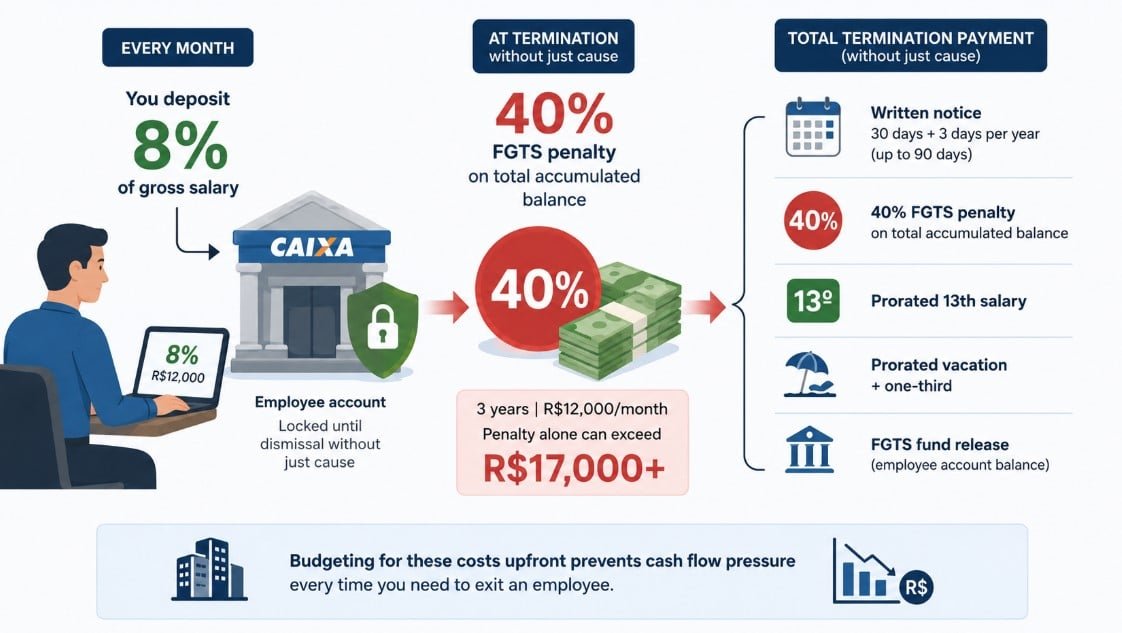
The financial impact of FGTS goes well beyond the 8% monthly deposit, because of what happens at termination. If you dismiss an employee without just cause — which includes most restructurings, performance-based exits where you haven’t documented a conduct cause, and layoffs — you owe an additional penalty of 40% of the total accumulated FGTS balance. On an employee who has been with your company for three years on a R$12,000 monthly salary, that penalty alone could exceed R$17,000.
The full termination payment for a CLT employee without just cause includes: written notice (30 days plus 3 additional days per year of service, up to 90 days), the 40% FGTS penalty on the total accumulated balance, prorated 13th salary, prorated vacation plus one-third, and FGTS fund release. Companies that don’t budget for this upfront face significant cash flow pressure every time they need to exit an employee.
The 13th Salary: Mandatory Year-End Bonus With Zero Exceptions
Brazil’s 13th salary — the décimo terceiro — is a constitutionally mandated annual bonus equal to one full month’s pay. It is not discretionary. It is not tied to performance. It is not something you can negotiate away in an employment contract. Every employee on a CLT contract is entitled to it, regardless of seniority level, salary, or company performance.
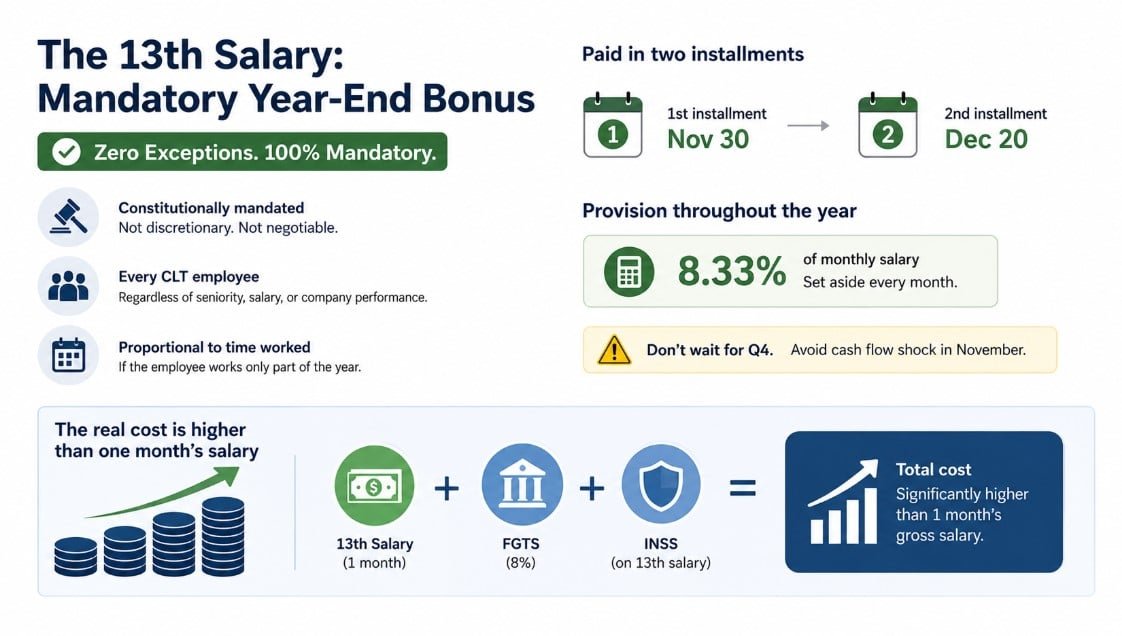
It’s paid in two installments: the first half by November 30, the second by December 20. If an employee works only part of the year, the payment is proportional to the months worked. The practical implication for finance teams is that you need to provision 8.33% of monthly salary throughout the year — not just budget for it in Q4. Foreign employers who don’t model this correctly face a significant cash flow shock in November when the first installment comes due.
On top of the 13th salary itself, you’re also contributing FGTS (8%) and INSS on the 13th salary payment. So the real cost of the 13th is higher than one month’s gross salary by the time all contributions are calculated.
Vacation Entitlements and the One-Third Bonus
After 12 months of service, every CLT employee is entitled to 30 calendar days of paid vacation. That much most international companies expect. What they often miss is the mandatory vacation bonus — an additional payment equal to at least one-third of the employee’s monthly salary — which must be paid when the employee takes their vacation, not at year end.
This bonus is on top of normal vacation pay, not instead of it. And if you fail to grant vacation within the legal period, the employee is entitled to double vacation pay. Accrued, unused vacation becomes a financial liability that compounds if not managed proactively.
Part Two: eSocial and the Real-Time Compliance Engine You Can’t Ignore
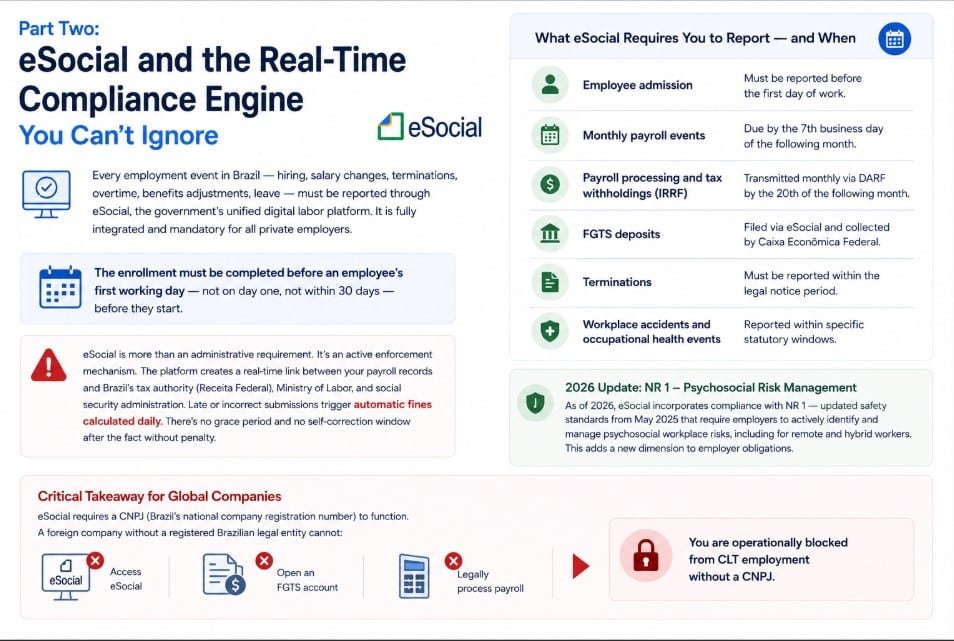
Every employment event in Brazil — hiring, salary changes, terminations, overtime, benefits adjustments, leave — must be reported through eSocial, the government’s unified digital labor platform. eSocial is fully integrated and mandatory for all private employers. The enrollment must be completed before an employee’s first working day — not on day one, not within 30 days — before they start.
eSocial is more than an administrative requirement. It’s an active enforcement mechanism. The platform creates a real-time link between your payroll records and Brazil’s tax authority (Receita Federal), Ministry of Labor, and social security administration. Late or incorrect submissions trigger automatic fines calculated daily. There’s no grace period and no self-correction window after the fact without penalty.
Related : Deel vs Oyster HR for Small Startups (Under 20 Employees) — 2026 Honest Comparison
What eSocial Requires You to Report — and When
The filing obligations under eSocial cover a wide range of employment events, each with its own deadline. Key examples:
- Employee admission: Must be reported before the first day of work
- Monthly payroll events: Due by the 7th business day of the following month
- Payroll processing and tax withholdings (IRRF): Transmitted monthly via DARF by the 20th of the following month
- FGTS deposits: Filed via eSocial and collected by Caixa Econômica Federal
- Terminations: Must be reported within the legal notice period
- Workplace accidents and occupational health events: Reported within specific statutory windows
eSocial also incorporates compliance with NR 1 — updated safety standards from May 2025 that require employers to actively identify and manage psychosocial workplace risks.This adds a new dimension to employer obligations for remote and hybrid workers that many foreign companies haven’t yet built into their processes.
The critical takeaway for global companies: eSocial requires a CNPJ (Brazil’s national company registration number) to function. A foreign company without a registered Brazilian legal entity cannot access eSocial, cannot open an FGTS account for employees, and cannot legally process payroll. You are operationally blocked from CLT employment without a local entity — or a provider who already has one.
Part Three: The PJ Problem — Why Contractor Arrangements Break Down in Brazil
Here’s where a lot of international companies get into serious trouble. To avoid the complexity and cost of CLT employment, many companies hire Brazilian workers as independent contractors — typically through a PJ structure (Pessoa Jurídica, meaning the individual registers a company and invoices for services). On paper, it looks clean. In practice, it’s one of the highest-risk employment decisions you can make in Brazil.
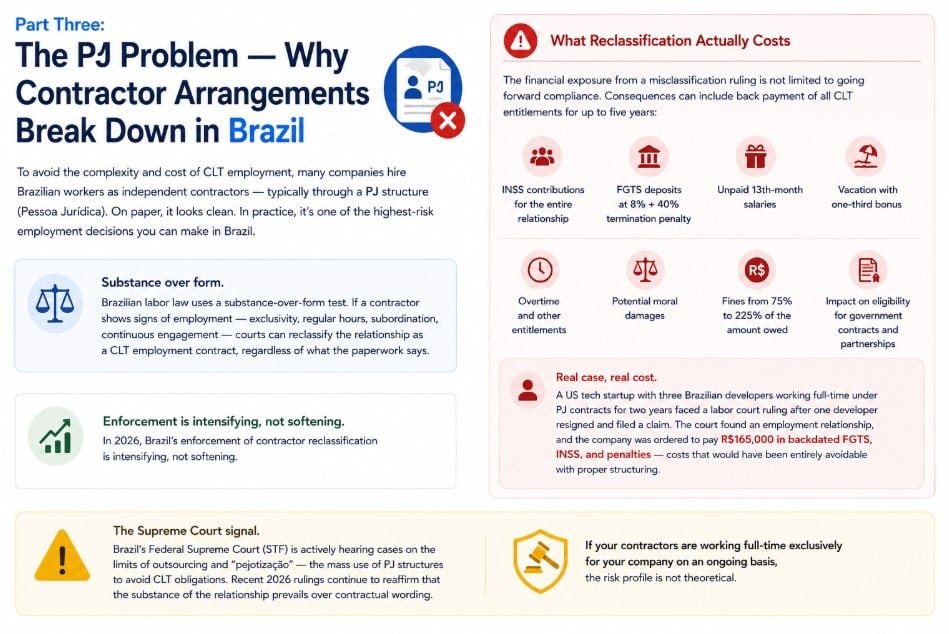
Brazilian labor law uses a substance-over-form test when evaluating worker relationships. If a contractor exhibits the characteristics of employment — exclusivity, regular working hours, subordination to management, continuous engagement — labor courts can reclassify the relationship as a CLT employment contract regardless of what the paperwork says. Brazil’s enforcement of contractor reclassification is intensifying, not softening.
What Reclassification Actually Costs
The financial exposure from a misclassification ruling is not limited to going forward compliance.The consequences of a misclassification ruling include back payment of all CLT entitlements for up to five years: INSS contributions for the entire relationship, FGTS deposits at 8% plus the 40% termination penalty, unpaid 13th-month salaries, vacation with the one-third bonus, overtime, and potentially moral damages.
To make that concrete: a US tech startup with three Brazilian developers working full-time under PJ contracts for two years faced a labor court ruling after one developer resigned and filed a claim. The court found an employment relationship, and the company was ordered to pay R$165,000 in backdated FGTS, INSS, and penalties — costs that would have been entirely avoidable with proper structuring.Fines for misclassification start at around BRL 400 per employee and escalate to 75 to 225% of the total amount owed, with large-scale cases reaching millions of reais. There’s also a reputational dimension: a misclassification finding can bar your company from bidding on Brazilian government contracts or partnering with large firms that require compliance certification from their vendors.
| ⚠️ The Supreme Court signal: Brazil’s Federal Supreme Court (STF) is actively hearing cases on the limits of outsourcing and what’s become known as ‘pejotização’ — the mass use of PJ structures to avoid CLT obligations. Recent 2026 rulings continue to reaffirm that the substance of the relationship prevails over contractual wording. If your contractors are working full-time exclusively for your company on an ongoing basis, the risk profile is not theoretical. |
Part Four: Entity vs. EOR — The Decision Every Global Company Faces
If you’ve read this far, you understand the compliance complexity. The next question is structural: how do you actually set up to hire in Brazil legally? There are two primary options, and the right choice depends on your team size, timeline, and long-term market commitment.
Setting Up a Brazilian Entity: Full Control, Real Complexity
A Brazilian legal entity — typically a Sociedade Limitada (LTDA) or Sociedade Anônima (SA) — gives you direct control over employment, payroll, and operations. You hold the CNPJ, you manage eSocial directly, and you’re not paying an EOR management fee over the long term. For companies with serious, multi-year commitments to the Brazilian market and teams of 10 or more, entity formation can eventually become the more cost-effective structure.
But the setup process is not quick or cheap. It involves:
- Registration with the Junta Comercial (Commercial Registry) at state level
- Federal CNPJ registration with Receita Federal
- State and municipal tax registrations, which vary by location and industry
- eSocial, FGTS, and INSS enrollment
- Corporate bank account setup — which requires a Brazilian-resident legal representative (procurador) with a CPF for foreign-owned entities
- Engagement of a local accountant (contador) for ongoing monthly filings
The typical entity formation timeline runs 4 to 6 months, with setup costs ranging from $15,000 to $30,000 when accounting for legal fees, accounting fees, minimum capital requirements, and administrative overhead. This guide puts the entity break-even point at 8 to 12+ employees, noting that Brazil’s compliance burden is so high that many companies maintain EOR relationships even with larger teams.
Hiring in Brazil is complex due to its intricate labor system, but an Employer of Record (EOR) like Deel simplifies the process by acting as the legal employer — handling contracts, payroll, taxes, and compliance — while you retain full operational control, letting you onboard Brazilian talent in days rather than the months it would take to set up your own local entity.
Using an Employer of Record: Speed, Compliance, and Flexibility
An Employer of Record (EOR) in Brazil is a local company that becomes the legal employer of your workers on paper while you retain day-to-day operational control. The EOR holds the CNPJ, registers employees on eSocial, handles FGTS and INSS deposits, manages payroll in Brazilian Reais, and administers mandatory benefits — all on your behalf. As RC Advocacia confirms, a foreign company without a Brazilian entity cannot hire directly under CLT, making an EOR the only viable path to fast, compliant market entry.
The EOR model makes the most sense when:
- You need to hire in weeks, not months
- You’re testing the market before committing to an entity
- Your team will remain under 8–10 employees for the foreseeable future
- You want to transfer employment liability — including labor court exposure — to a provider with deep local expertise
- You’re scaling across multiple countries and want a unified platform rather than separate local setups in each market
| Not all EORs are equal in Brazil. The complexity of eSocial, collective bargaining agreements (CCTs), and state-level payroll variations means your provider’s local infrastructure matters enormously. The key capabilities to verify: eSocial direct integration, owned (not partner) Brazilian entity, CLT specialization across all 26 states, and explicit handling of termination workflows including the 40% FGTS penalty calculation. |
Part Five: How Deel Handles Brazilian Compliance
For companies choosing the EOR route in Brazil, Deel’s local infrastructure is built specifically around the compliance requirements described in this guide. Here’s how the platform addresses each of the major pain points:
eSocial Integration — Native, Not Bolted On
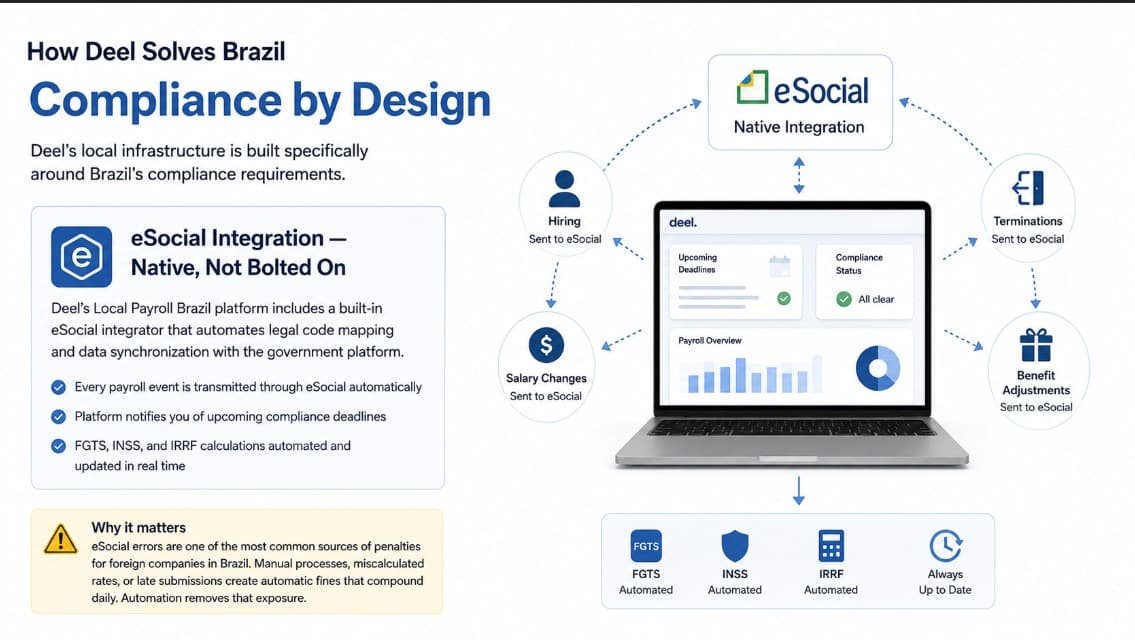
Deel’s Local Payroll Brazil platform includes a built-in eSocial integrator that automates legal code mapping and data synchronization with the government platform. Every payroll event — hiring, salary changes, terminations, benefit adjustments — is transmitted through eSocial automatically, with the platform notifying payroll managers of upcoming compliance deadlines before they arrive. FGTS, INSS, and IRRF calculations are automated and updated in real time when regulations change.
This matters because eSocial errors are one of the most common sources of penalties for foreign companies operating in Brazil. Manual processes, miscalculated rates, or late submissions create automatic fines that compound daily. Automation removes that exposure.
CLT-Compliant Employment Contracts in Portuguese
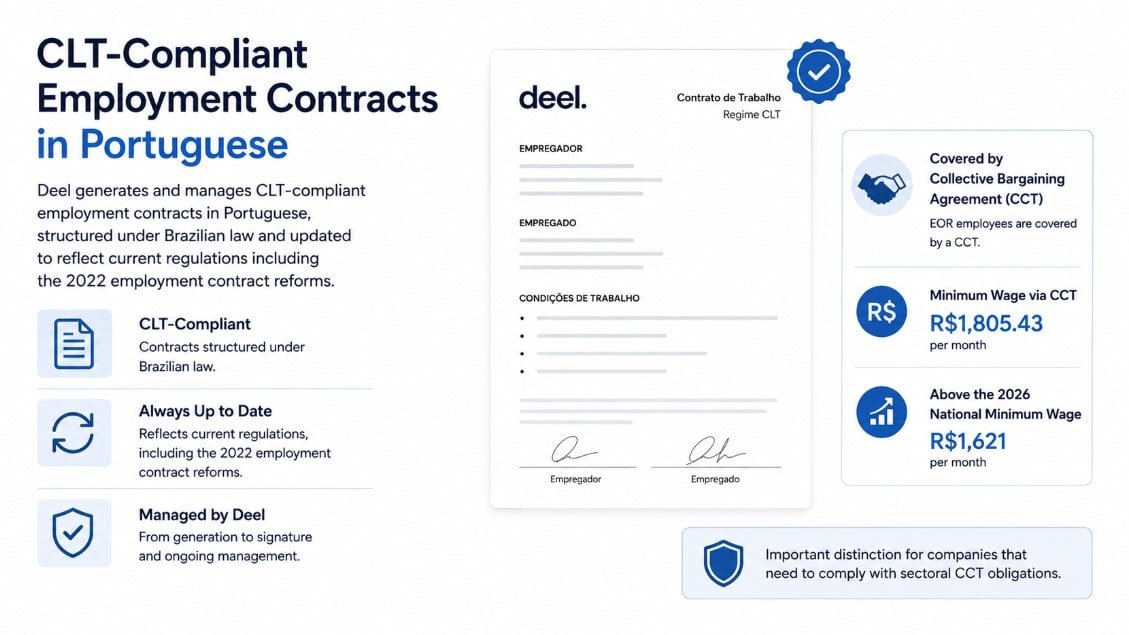
Deel generates and manages CLT-compliant employment contracts in Portuguese, structured under Brazilian law and updated to reflect current regulations including the 2022 employment contract reforms. As noted on Deel’s Brazil employee page, EOR employees are covered by a collective bargaining agreement (CCT) that provides a minimum wage of R$1,805.43 per month — above the 2026 national minimum wage of R$1,621 — which is an important distinction for companies that need to comply with sectoral CCT obligations.
FGTS and INSS Management, Including Termination Workflows
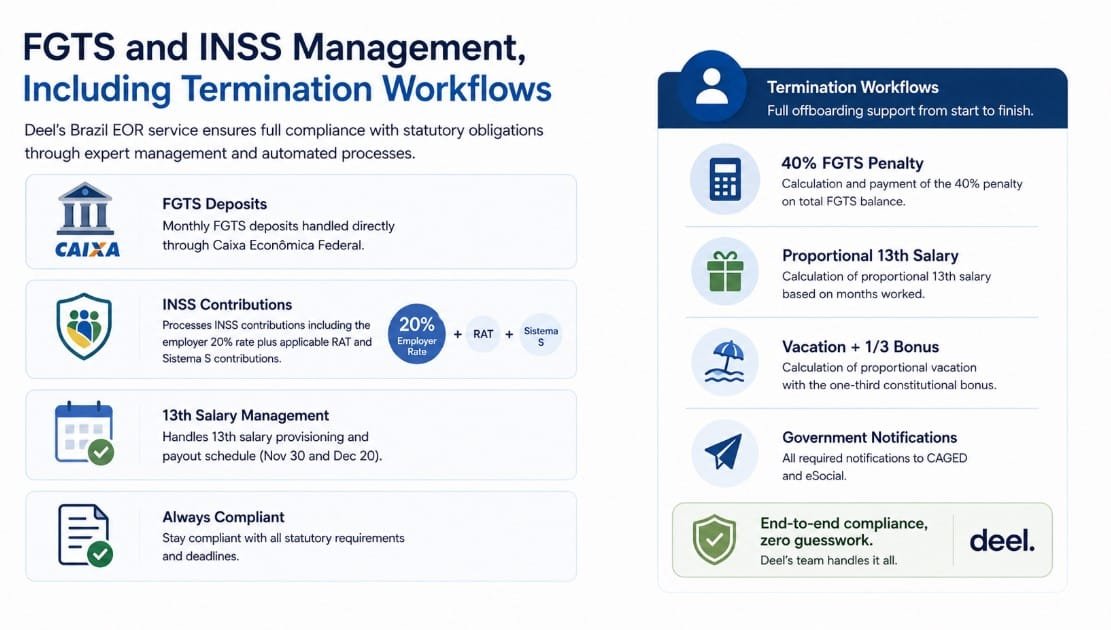
Deel’s Brazil EOR service handles monthly FGTS deposits directly through Caixa Econômica Federal, processes INSS contributions including the employer 20% rate plus applicable RAT and Sistema S contributions, and manages the 13th salary provisioning and payout schedule. For terminations, Deel’s team handles the full offboarding workflow — including calculation of the 40% FGTS penalty, proportional 13th salary, vacation with the one-third bonus, and all required notifications to CAGED and eSocial.
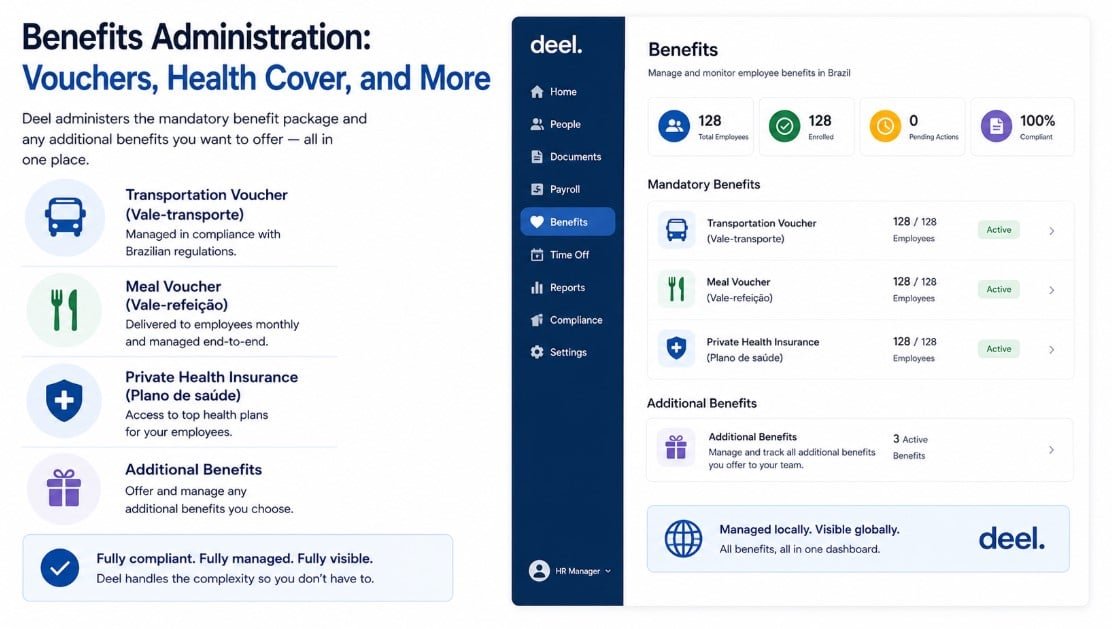
Benefits Administration: Vouchers, Health Cover, and More
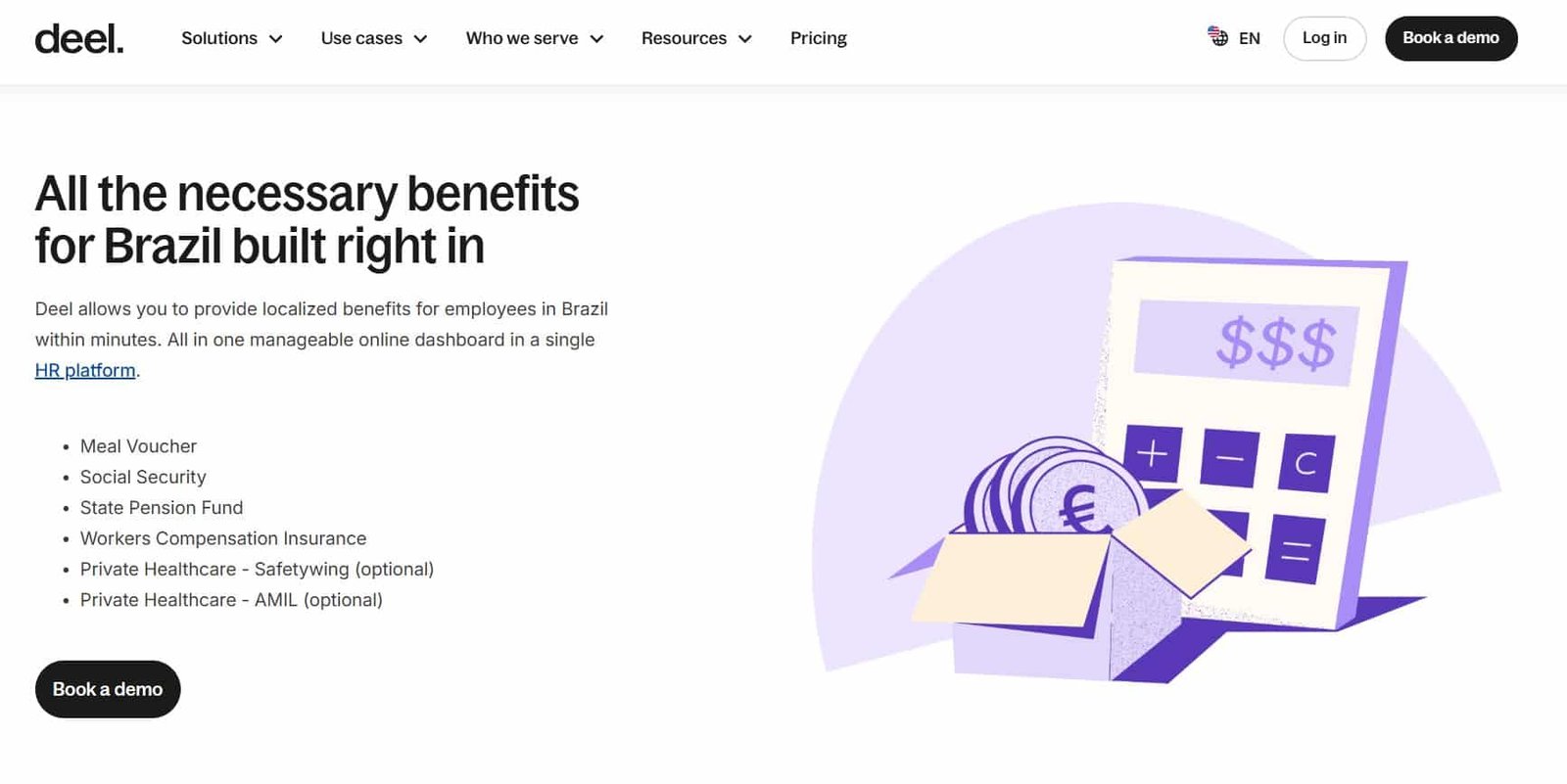
Deel administers the mandatory benefit package — transportation vouchers (vale-transporte), meal vouchers (vale-refeição), and private health insurance (plano de saúde) — along with any additional benefits you want to offer. Everything is managed through a single dashboard, which is a meaningful operational advantage when your HR team is based outside Brazil and doesn’t have day-to-day visibility into local benefit administration timelines.
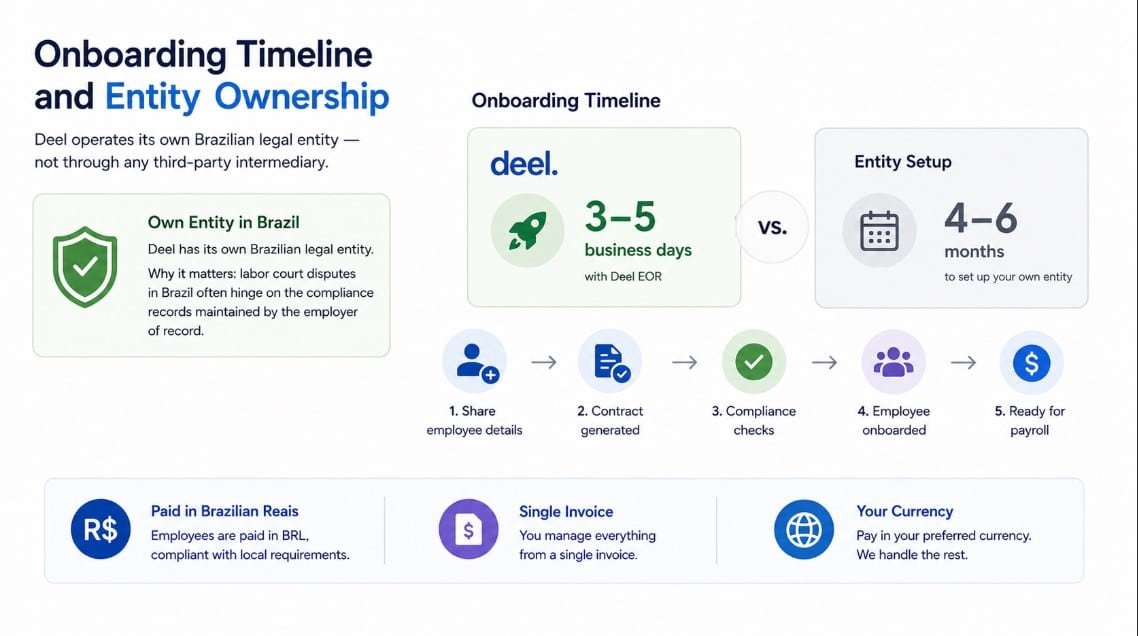
Onboarding Timeline and Entity Ownership
Deel operates its own Brazilian legal entity — it doesn’t partner through a third-party intermediary for Brazil. As eorHQ’s 2026 EOR comparison notes, this matters in Brazil more than most countries given that labor court disputes often hinge on the compliance records maintained by the employer of record. With Deel, onboarding typically takes 3 to 5 business days — compared to 4 to 6 months for entity setup — and employees are paid in Brazilian Reais while you manage everything from a single invoice in your preferred currency.
Ready to Hire in Brazil Without the CLT Exposure?
If your company is planning to hire full-time employees in Brazil — or if you already have workers on informal PJ contracts and want to understand what reclassification exposure looks like — Deel’s Brazil EOR team can walk you through a specific compliance assessment for your situation.
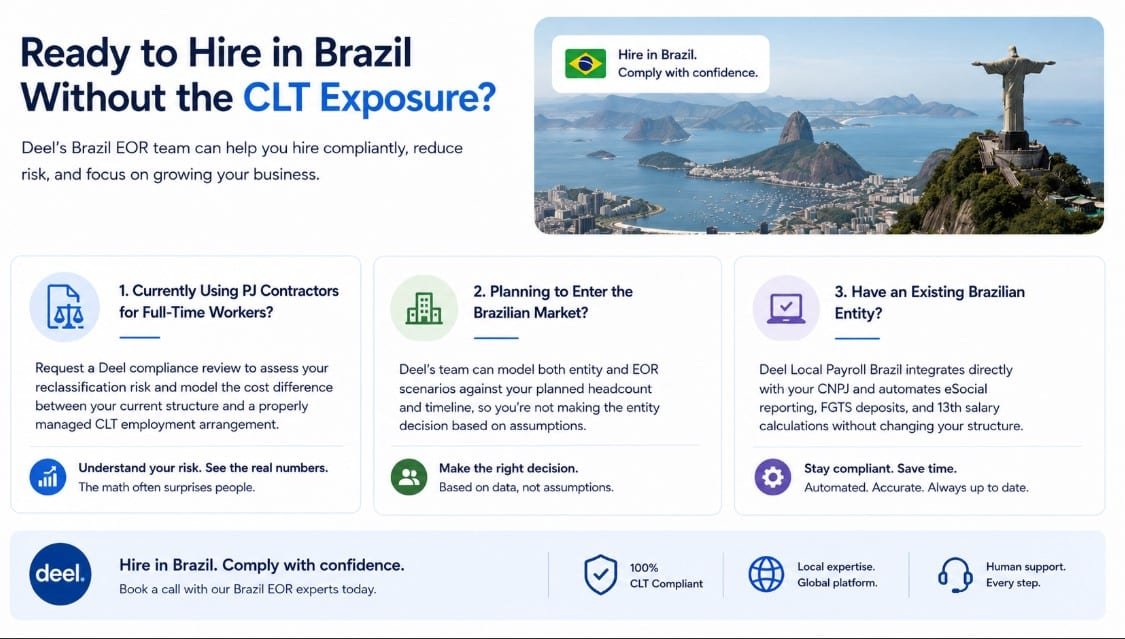
| If you’re currently relying on PJ contractor arrangements for full-time Brazilian workers: Request a Deel compliance review to assess your reclassification risk and model the cost difference between your current structure and a properly managed CLT employment arrangement. The math often surprises people. If you’re planning to enter the Brazilian market and deciding between entity and EOR: Deel’s team can model both scenarios against your planned headcount and timeline, so you’re not making the entity decision based on assumptions. If you have an existing Brazilian entity and need help with eSocial compliance and payroll: Deel Local Payroll Brazil integrates directly with your CNPJ and automates eSocial reporting, FGTS deposits, and 13th salary calculations without requiring you to change your employment structure. |
You can explore Deel's Brazil-specific capabilities and get a pricing estimate at deel.com/hiring/employees/brazil, or book a consultation with their Latin America compliance team directly through the platform.The Bottom Line
Brazil rewards companies that treat compliance as a first-class concern. The talent pool is genuinely exceptional, compensation levels are competitive in global terms, and the market itself is large enough to justify serious long-term investment. But the CLT is not a framework you can approximate or navigate around. The labor courts are active, the enforcement mechanisms are automated, and the financial consequences of misclassification or payroll non-compliance compound quickly.
The most expensive mistake global companies make in Brazil isn’t paying too much in employer costs — it’s underestimating them, structuring around them with contractor arrangements that won’t survive scrutiny, and then facing retroactive liability for everything they tried to avoid. Getting the structure right upfront is the decision that determines whether Brazil becomes a genuine asset to your global team or an expensive lesson in labor law.
That’s exactly where Deel comes in. With a wholly-owned Brazilian entity, in-house CLT and LGPD expertise, and real-time compliance monitoring, Deel lets you hire confidently in Brazil from day one — no entity setup, no payroll guesswork, no surprise penalties. Whether you’re making your first Brazilian hire or scaling an entire team, Deel handles the statutory heavy lifting so you can focus on growth.
Ready to hire in Brazil the right way? Book a Deel demo today.
The compliance framework described in this guide reflects regulations current as of June 2026. Brazilian labor law evolves through legislative amendment, STF rulings, and annual regulatory updates. Verify specific rates and thresholds — particularly INSS ceilings, minimum wage, and FGTS contribution rules — against current Ministério do Trabalho e Emprego guidance before making employment decisions.Next : Deel vs Remote vs Rippling: Best EOR for Scaling Agencies