There’s a good chance you’ve already googled this comparison at least once. Maybe you’re paying for Mailchimp and wondering if you’ve outgrown it. Maybe someone on your team swears by HubSpot and another person keeps mentioning Klaviyo. Or maybe you’re starting fresh and trying to avoid the pain of migrating platforms eighteen months from now.
These four platforms collectively power email marketing for tens of millions of businesses, but they were built for very different problems. Choosing the wrong one doesn’t just cost you money — it costs you time, migration headaches, and the automation work you’ll eventually have to rebuild. This comparison cuts through the marketing copy to give you a clear picture of how each tool actually behaves in practice.
One more thing before we dive in: email still delivers an average ROI of $36 for every $1 spent — and up to $72 for US ecommerce brands. The platform you choose has a direct impact on how much of that return you actually capture. So let's make sure you pick the right one.Table of Contents
First, the Quick Take
If you’re pressed for time and just need a directional answer:
- ActiveCampaign — Best for growing SMBs, B2B companies, SaaS, and anyone who needs real marketing automation with a built-in CRM at a reasonable price.
- HubSpot — Best for enterprise teams or those already deep in the HubSpot ecosystem who need sales, service, and marketing unified on a single platform and have the budget to match.
- Klaviyo — Best for ecommerce brands (especially Shopify stores) where email and SMS revenue attribution and product-level personalization are the main goals.
- Mailchimp — Best for very small businesses or solo operators who need basic email sending, value an enormous template library, and aren’t ready for automation complexity.
Now let’s look at why — and where those neat categories start to break down.
Side-by-Side: At a Glance – ActiveCampaign vs. HubSpot vs. Klaviyo vs. Mailchimp
The comparison below is based on publicly available pricing and feature information using annual billing for 1,000 contacts as a baseline. Pricing tiers, feature inclusions, and plan structures can change — we recommend confirming current details directly with each provider before making a purchase decision.
| Feature | ActiveCampaign | HubSpot | Klaviyo | Mailchimp |
| Starting Price (1K contacts) | $29/mo | $20/seat | $45/mo | $26.50/mo |
| Mid-tier (comparable) | $49/mo | $890/mo (Pro) | $100/mo (5K) | ~$80/mo |
| Built-in CRM | ✓ Native | ✓ Native (flagship) | ✗ Limited | ✗ Basic |
| Automation Depth | ★★★★★ | ★★★★☆ | ★★★★☆ | ★★★☆☆ |
| Ecommerce Focus | ★★★☆☆ | ★★★☆☆ | ★★★★★ | ★★★☆☆ |
| B2B / SaaS Fit | ★★★★★ | ★★★★★ | ★★☆☆☆ | ★★★☆☆ |
| Ease of Use | ★★★☆☆ | ★★★★☆ | ★★★★☆ | ★★★★★ |
| Deliverability | High | High | High | High |
| Free Plan | 14-day trial | Yes (limited) | 250 contacts | Yes (500 contacts) |
| Best For | Growing SMBs, B2B, SaaS | Enterprise, full-suite | Ecommerce brands | Beginners, small lists |
A few things stand out immediately. HubSpot's Professional tier — which is where meaningful automation actually lives — starts at $890/month, a stark contrast to ActiveCampaign's comparable Plus tier at $49/month. That's not a typo. And Klaviyo's pricing, while competitive for ecommerce revenue, climbs quickly with list size.Mailchimp: The One Everyone Starts With
What It Does Well
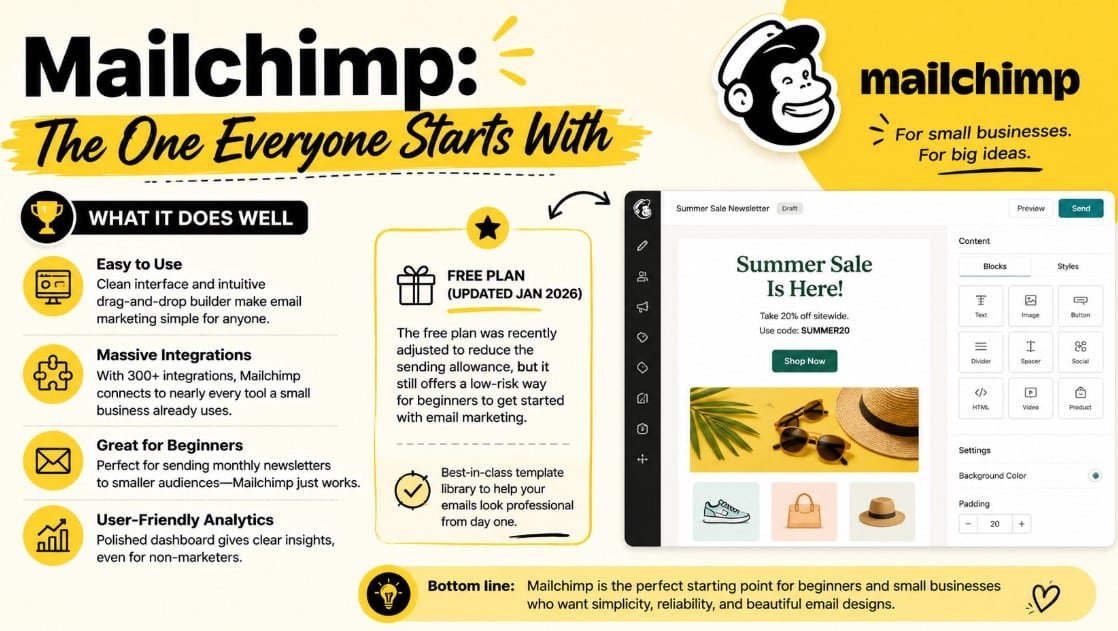
Mailchimp built its reputation on being approachable, and that’s still true. The interface is clean, the drag-and-drop builder is intuitive, and with over 300 integrations, it connects to nearly every tool a small business already uses. For someone sending a monthly newsletter to 500 people, Mailchimp just works.
The free plan — recently adjusted to reduce the sending allowance — still gives beginners a low-risk starting point. The template library is genuinely one of the best in the industry, and the analytics dashboard is polished enough to give non-marketers a clear picture of what’s happening.
Where It Falls Short
The cracks appear quickly once you start scaling. Mailchimp’s automation — branded as Marketing Automation Flows — handles basic sequences like welcome emails and abandoned cart reminders, but conditional branching, goal tracking, and complex behavioral workflows hit a wall. You can’t build a sophisticated lead nurture sequence the way you can in ActiveCampaign or even Klaviyo.
The pricing model also creates friction. Mailchimp counts contacts per audience, so if the same person appears on two lists, you’re billed twice. Paid plans start at $26.50/month for 1,000 contacts, and costs scale steeply as your list grows. By the time you have 25,000 contacts, you’re paying significantly more than you would on ActiveCampaign — for noticeably less automation capability.
The honest verdict on Mailchimp: it's the right tool for year one of your business. For most companies, that's all it should be.Klaviyo: The Ecommerce Specialist
What It Does Well
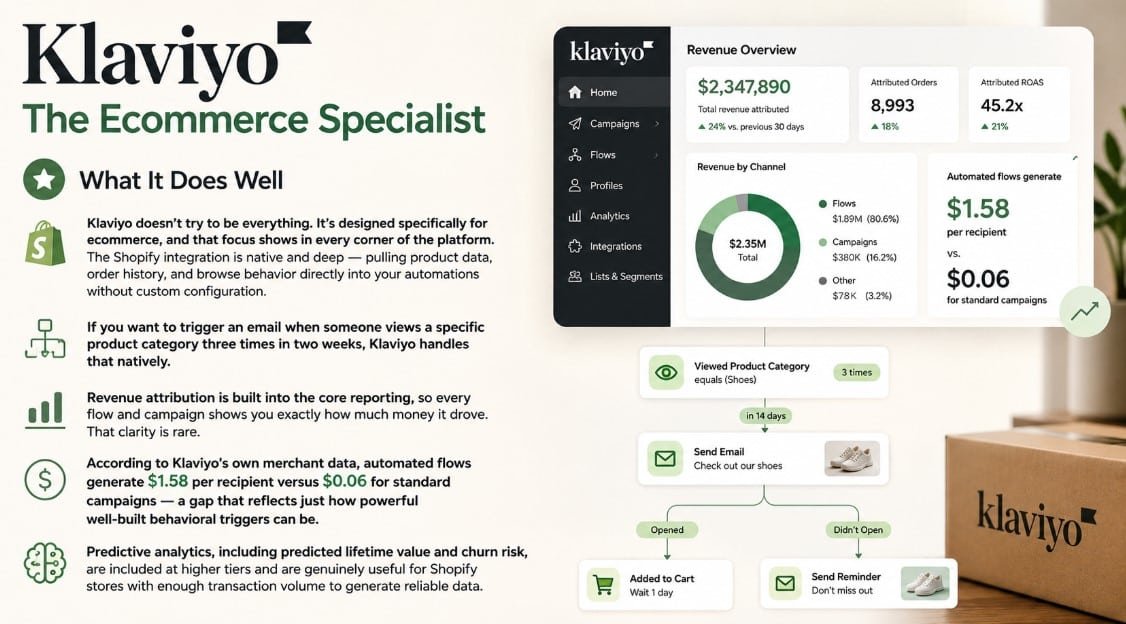
Klaviyo doesn’t try to be everything. It’s designed specifically for ecommerce, and that focus shows in every corner of the platform. The Shopify integration is native and deep — pulling product data, order history, and browse behavior directly into your automations without custom configuration. If you want to trigger an email when someone views a specific product category three times in two weeks, Klaviyo handles that natively.
Revenue attribution is built into the core reporting, so every flow and campaign shows you exactly how much money it drove. That clarity is rare. According to Klaviyo’s own merchant data, automated flows generate $1.58 per recipient versus $0.06 for standard campaigns — a gap that reflects just how powerful well-built behavioral triggers can be.
Predictive analytics, including predicted lifetime value and churn risk, are included at higher tiers and are genuinely useful for Shopify stores with enough transaction volume to generate reliable data.
Where It Falls Short
Klaviyo’s ecommerce depth is also its limitation. For B2B companies, SaaS businesses, or service firms, the platform simply wasn’t designed with their workflows in mind. There’s no meaningful CRM, lead scoring is rudimentary, and the automation logic doesn’t map well to long B2B sales cycles.
Pricing is the other concern. Klaviyo bills on all active profiles — every subscribed contact in your account, whether you emailed them recently or not. At 5,000 contacts, you’re paying $100/month. At 25,000, you’re at $400/month. Compare that to ActiveCampaign Plus at $49 and $186 respectively, and the gap becomes hard to ignore unless ecommerce-specific features are genuinely driving revenue that justifies the premium.
The honest verdict on Klaviyo: for serious Shopify stores doing $500K or more annually, it's probably the right choice. For everyone else, the premium rarely pays off.HubSpot: The Enterprise All-In-One
What It Does Well
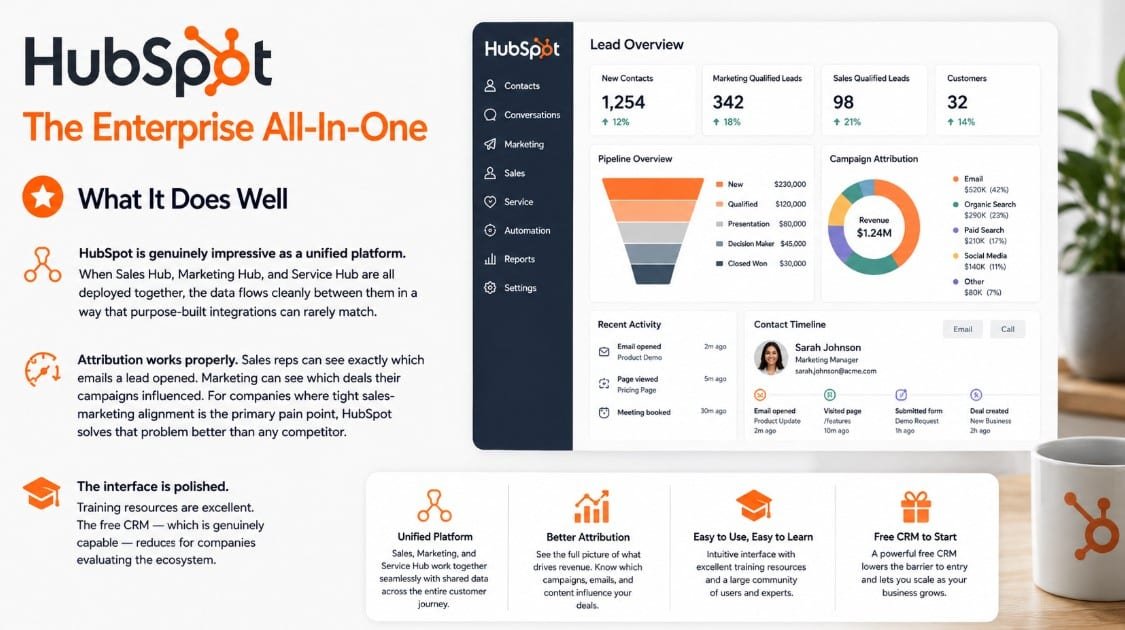
HubSpot is genuinely impressive as a unified platform. When Sales Hub, Marketing Hub, and Service Hub are all deployed together, the data flows cleanly between them in a way that purpose-built integrations can rarely match. Attribution works properly. Sales reps can see exactly which emails a lead opened. Marketing can see which deals their campaigns influenced. For companies where tight sales-marketing alignment is the primary pain point, HubSpot solves that problem better than any competitor.
The interface is polished. Training resources are excellent. The free CRM — which is genuinely capable — reduces the barrier to entry for companies evaluating the ecosystem.
Where It Falls Short
The pricing structure is where HubSpot separates the seriously interested from the merely curious. Marketing Hub Professional starts at $890/month for annual billing — and that comes with a mandatory $3,000 onboarding fee in year one. Enterprise starts at $3,600/month. Meaningful automation, A/B testing, and custom reporting are all gated behind the Professional tier. The Starter plan at $20/seat/month is quite limited by comparison.
For a growing business that just needs sophisticated email automation and a CRM, paying $890/month when ActiveCampaign’s Plus plan covers similar automation territory at $49/month is a hard number to justify. You’re paying for platform breadth, not automation depth.
The honest verdict on HubSpot: if you're an enterprise company that needs Marketing, Sales, and Service under one roof and has the budget, HubSpot earns its price. If email automation is your core need, you're overpaying significantly.ActiveCampaign: The Automation Powerhouse for Growing Businesses
Where It Stands Apart
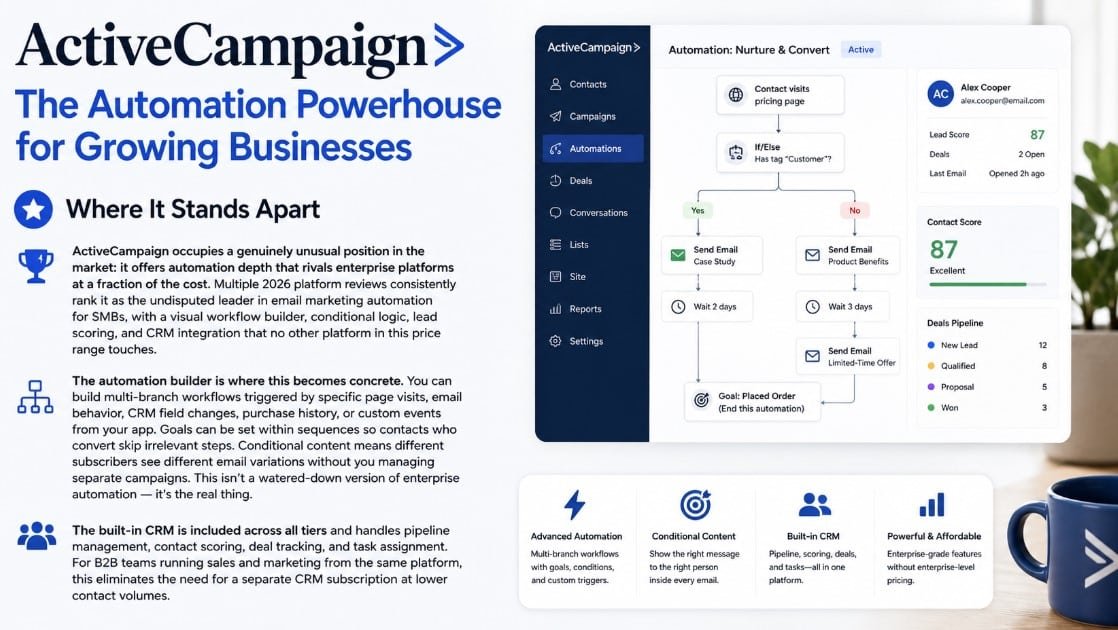
ActiveCampaign occupies a genuinely unusual position in the market: it offers automation depth that rivals enterprise platforms at a fraction of the cost. ActiveCampaign consistently rank it as the undisputed leader in email marketing automation for SMBs, with a visual workflow builder, conditional logic, lead scoring, and CRM integration that no other platform in this price range touches.
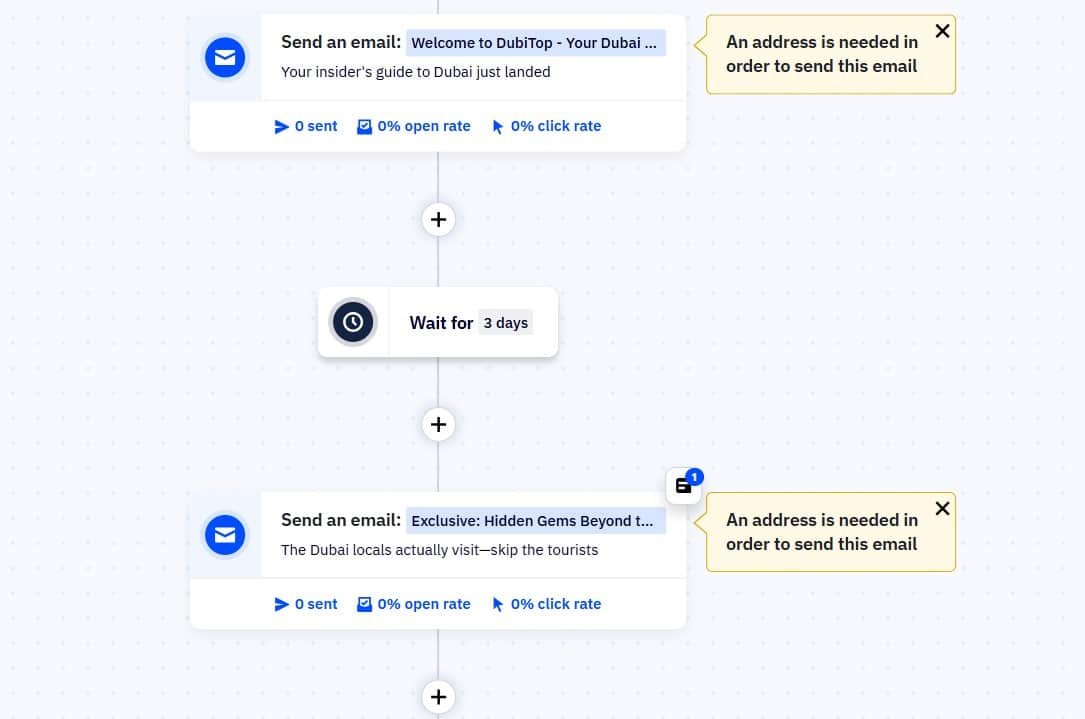
The automation builder is where this becomes concrete. You can build multi-branch workflows triggered by specific page visits, email behavior, CRM field changes, purchase history, or custom events from your app. Goals can be set within sequences so contacts who convert skip irrelevant steps. Conditional content means different subscribers see different email variations without you managing separate campaigns. This isn’t a watered-down version of enterprise automation — it’s the real thing.
The built-in CRM is included across all tiers and handles pipeline management, contact scoring, deal tracking, and task assignment. For B2B teams running sales and marketing from the same platform, this eliminates the need for a separate CRM subscription at lower contact volumes.
Pricing That Makes Sense
Let’s be honest — most email marketing tools either charge too little and leave you hitting walls the moment you try to scale, or charge enterprise rates before you’ve earned enterprise revenue. ActiveCampaign sits in the sweet spot.
You can get started for as little as $15/month on the Starter plan, which is genuinely useful — not a stripped-down trial dressed up as a real tier. When your needs grow, Plus at $49/month is where most serious businesses land.
For that price, you’re getting unlimited automation actions, landing pages, and full CRM and ecommerce integrations — tools that would cost significantly more bundled together elsewhere. Pro at $79/month adds advanced segmentation, predictive content, attribution tracking, and support for up to 3 users, which makes it a strong fit for teams starting to scale their marketing operation. Enterprise at $145/month brings dedicated support, SSO, custom objects, and the kind of infrastructure larger organisations actually need.
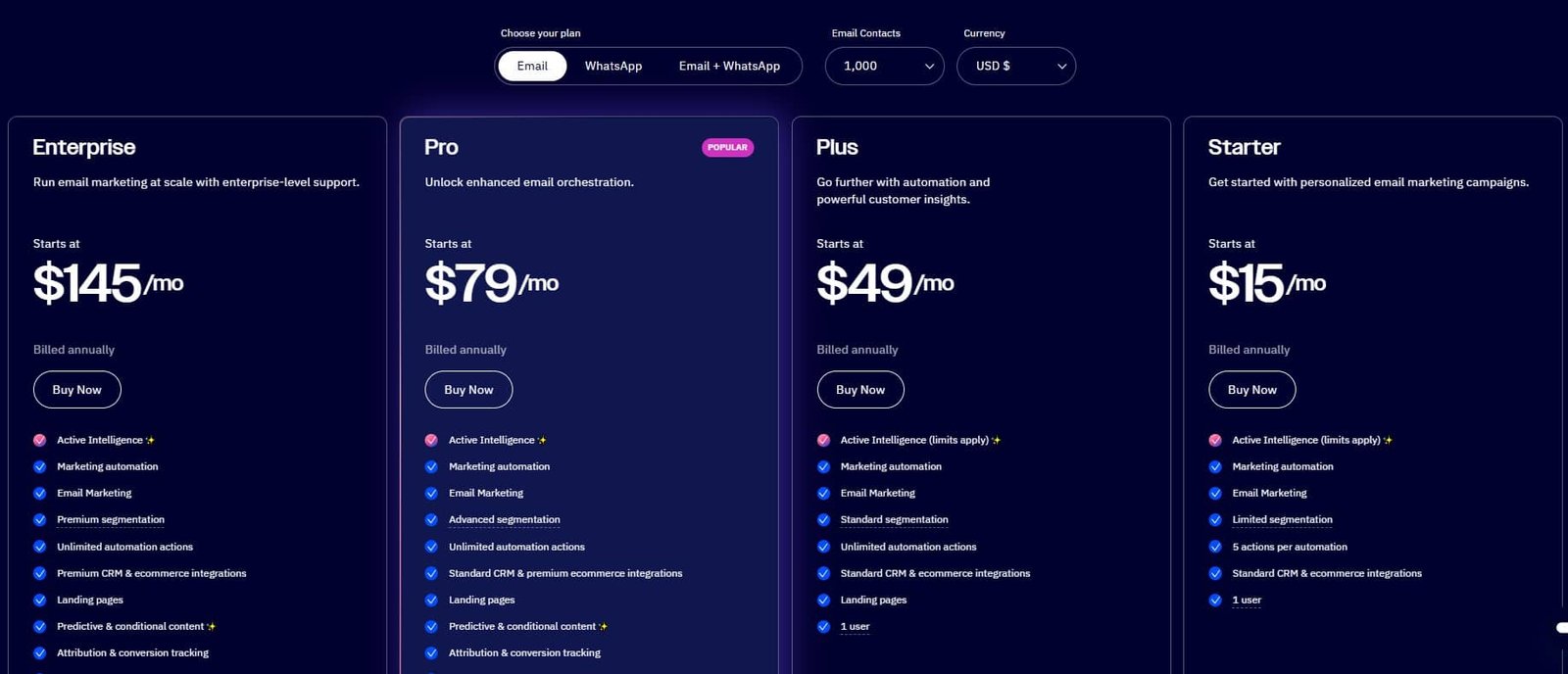
All plans are billed annually, which keeps costs predictable — no surprise invoices mid-campaign. And with deliverability consistently rated at 93.4% in independent testing, you’re not just paying for features — you’re paying for emails that actually reach inboxes, which is where revenue is made or lost.
Compared to HubSpot, where comparable functionality can run many times higher per month, ActiveCampaign gives you professional-grade automation without the professional-grade sticker shock.
Ready to see what it looks like for your business? Start your free 14-day trial of ActiveCampaign — no credit card required.Where It’s Honest About Its Limits
ActiveCampaign’s reporting dashboard is functional but less visually polished than Mailchimp’s. The initial learning curve is real — the platform’s depth can look overwhelming to someone coming from a basic email tool, and there’s more to configure upfront. The onboarding resources (including pre-built automation recipes and AI-powered agents) help, but this isn’t a tool you’ll be sending from on day one.
For pure ecommerce, Klaviyo’s native Shopify data model is deeper. ActiveCampaign supports cart abandonment and WooCommerce/Shopify integrations well, but requires additional configuration time compared to Klaviyo’s plug-and-play approach. For stores doing serious ecommerce volume, that difference matters.
The honest verdict on ActiveCampaign: for the vast majority of growing businesses — B2B, SaaS, service companies, agencies, coaches, and consultants — nothing in this price range comes close to what you get. The automation is real, the CRM is included, and the pricing scales rationally.Making the Decision: Which Platform Fits Your Business?
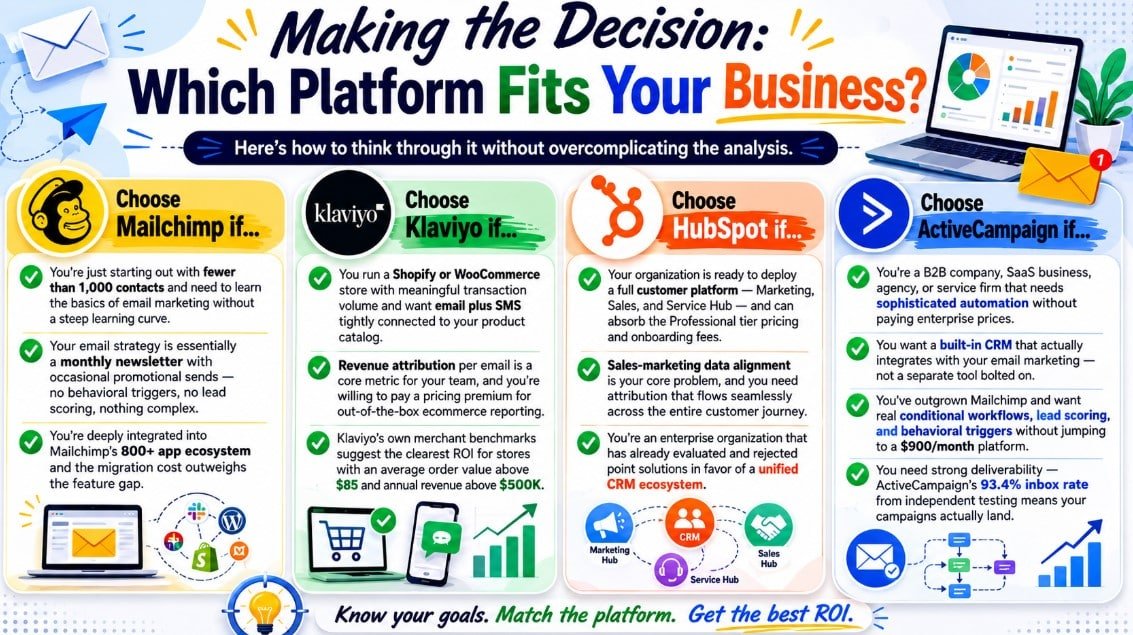
Here’s how to think through it without overcomplicating the analysis.
Choose Mailchimp if…
- You’re just starting out with fewer than 1,000 contacts and need to learn the basics of email marketing without a steep learning curve.
- Your email strategy is essentially a monthly newsletter with occasional promotional sends — no behavioral triggers, no lead scoring, nothing complex.
- You’re deeply integrated into Mailchimp’s 800+ app ecosystem and the migration cost outweighs the feature gap.
Choose Klaviyo if…
- You run a Shopify or WooCommerce store with meaningful transaction volume and want email plus SMS tightly connected to your product catalog.
- Revenue attribution per email is a core metric for your team, and you’re willing to pay a pricing premium for out-of-the-box ecommerce reporting.
- Klaviyo’s own merchant benchmarks suggest the clearest ROI for stores with an average order value above $85 and annual revenue above $500K.
Choose HubSpot if…
- Your organization is ready to deploy a full customer platform — Marketing, Sales, and Service Hub — and can absorb the Professional tier pricing and onboarding fees.
- Sales-marketing data alignment is your core problem, and you need attribution that flows seamlessly across the entire customer journey.
- You’re an enterprise organization that has already evaluated and rejected point solutions in favor of a unified CRM ecosystem.
Choose ActiveCampaign if…
- You’re a B2B company, SaaS business, agency, or service firm that needs sophisticated automation without paying enterprise prices.
- You want a built-in CRM that actually integrates with your email marketing — not a separate tool bolted on.
- You’ve outgrown Mailchimp and want real conditional workflows, lead scoring, and behavioral triggers without jumping to a $900/month platform.
- You need strong deliverability — ActiveCampaign’s 93.4% inbox rate from independent testing means your campaigns actually land.
The Real Cost Comparison Nobody Shows You
Headline pricing rarely tells the full story. Here’s what 25,000 contacts actually costs you annually on each platform (approximate, based on publicly available 2026 pricing):
- ActiveCampaign Plus: ~$3,828/year
- Klaviyo (email only): ~$4,800/year
- HubSpot Marketing Professional: ~$10,680/year (plus a mandatory $3,000 onboarding fee in year one)
- Mailchimp Standard: ~$3,240–$3,600/year
That HubSpot number is the one that stops people mid-spreadsheet. You’re paying nearly three times more than ActiveCampaign for broadly comparable automation features. The $890/month Professional tier makes sense if your team is living inside the full HubSpot stack — CRM, sales, service, the whole thing. For standalone email marketing and automation, it’s a hard number to justify.
Klaviyo’s premium over ActiveCampaign is more defensible — but only if you’re running an ecommerce operation where native revenue attribution and product-based segmentation are generating measurable returns. For everyone else, paying roughly $80/month more adds up to nearly $1,000 a year for features that simply don’t apply to your business model. At 25,000 contacts, that gap is real money.
A Word on Deliverability
Deliverability is underrated in platform comparisons. You can build the perfect automation, craft the ideal subject line, and still have your email land in the Promotions tab or, worse, the spam folder. Platform infrastructure matters.
All four platforms in this comparison have strong deliverability track records when list hygiene is maintained. ActiveCampaign’s independently measured 93.4% inbox rate is among the best in the industry. Klaviyo and Mailchimp are close behind for clean lists. HubSpot’s deliverability is generally solid, though some users on shared IP pools report more variability.
The bigger deliverability risk isn’t the platform — it’s the list. Mailchimp’s duplicate-counting model can tempt users to keep all contacts in all audiences rather than actively cleaning. That inflates bounce rates and hurts sender reputation. ActiveCampaign’s single-contact model makes list hygiene easier to manage.
The Bottom Line
For most businesses reading this comparison, the decision comes down to one question: how sophisticated does your marketing need to be, and what are you willing to pay for it?
Mailchimp is fine for businesses in their infancy. Klaviyo is excellent for ecommerce brands with the revenue to justify its pricing. HubSpot is exceptional for enterprises that need everything under one roof. But for the broad middle — growing companies, B2B businesses, SaaS products, agencies, and consultancies that need real automation without a six-figure software budget — ActiveCampaign consistently delivers more than any other platform at its price point.
The automation isn’t watered down. The CRM is built in. The deliverability holds up. And the pricing scales in a way that doesn’t punish you for growing. In a market full of platforms that promise everything and deliver a fraction of it, that’s a harder combination to find than it sounds.
Whatever platform you choose, the underlying principle is the same: the best email marketing tool is the one your team will actually use, configure properly, and optimize consistently. But starting on the right foundation makes all of that significantly easier.
Pricing data and platform features were verified against official pricing pages and independent third-party sources. All figures reflect annual billing unless otherwise stated. Platform features and pricing are subject to change — always verify current information on the vendor’s official website before making a purchasing decision.This article may contain affiliate links. If you purchase a product through one of these links, we may earn a commission at no additional cost to you