How to Use AI Visual Tools to Boost Your Content Marketing ROI : Scale Visuals, Lower Costs, Drive Results.
If you are still paying freelancers $150-$400 per ad video and waiting 3-5 days for delivery, you are leaving money on the table. Ad clone technology has changed the math — you can now upload a winning reference ad, let AI extract its hook timing, pacing, and CTA structure, and generate brand-safe variations in minutes instead of days. Visual content drives 40% more ROI on average than campaigns without visuals, according to Zebracat’s research. That is the difference between a campaign that pays for itself and one that does not.
Between blog images, social graphics, product shots, and ad creative, AI visual tools — led by ad clone capabilities — now handle the heavy lifting that used to cost thousands a month, and they do it in minutes instead of days.
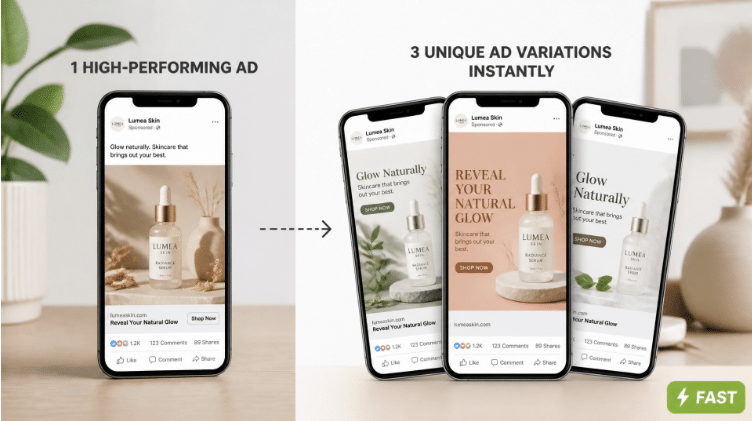
The Visual Content Gap — And Where Ad Clone Fits In
Here’s the thing about visual content: most teams are bleeding budget on it and they don’t even know. Let me show you the math.
A marketer running a blog, two social channels, paid ads, and a monthly newsletter might need anywhere from 40 to 80 original images and videos per month. Hire a freelance designer at $40-$80 per graphic and you are looking at $1,600-$6,400 a month.
For video ads, the numbers get worse — a single 30-second ad spot from a freelancer runs $150-$400. And you need multiple variations to test properly.
And here is the kicker: pages with images receive 94% more views than text-only pages, per Outbrain data. Facebook posts with images get 2.3x more engagement (BuzzSumo). Cutting visuals to save money doesn’t save you anything — it costs you traffic and conversions.
Here’s what I’ve learned from running content operations: the gap between “what visuals cost” and “what skipping visuals costs” is where most teams bleed budget without realizing it. AI visual tools sit right in that gap. And the single biggest lever? Ad clone — it turns the most expensive line item (paid ad creative) into a near-zero-cost testing pipeline.
How Ad Clone and AI Visual Tools Changed the Game
In 2025, 68% of marketers reported using AI-powered tools to create or enhance visual content, up from just 40% in 2021. That is not a trend — it is a mass migration.
Here is what these tools actually let you do. Type a description of the image you want — a blog header, a product lifestyle shot, a Facebook ad visual — and the tool generates it in seconds. Need variations for different platforms? Same concept, different aspect ratio, done in under a minute. Want to turn a product photo into a scene with a background that matches your brand palette? Upload, describe, generate. I do this daily and it still feels like magic.
Now take it a step further: ad creative. Instead of guessing what hooks, pacing, and CTAs will convert, you upload a winning ad from your swipe file and let AI rebuild the same proven structure around your product.
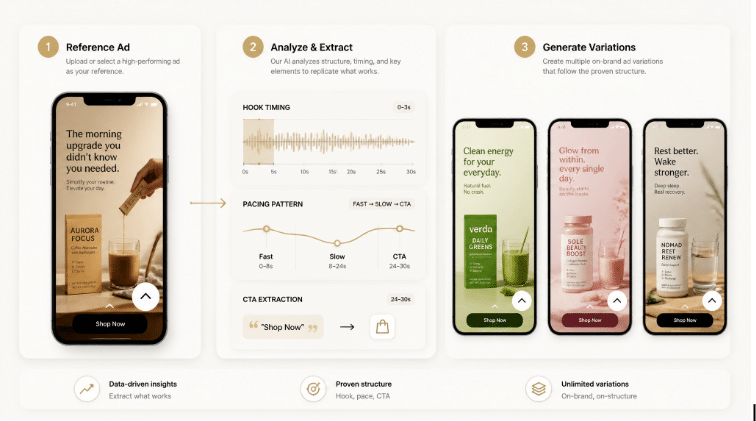
This is what VisualGPT’s Ad Clone does — it extracts hook timing, pacing, and CTA flow from any reference ad, then generates brand-safe variations in minutes. A growth marketer I know tried this and reported a 34% ROAS increase in their first month. Why? Because they could finally test more creative variations without burning the budget on production.
The productivity numbers back this up: marketers using AI tools report a 25-40% reduction in content production time, per Venngage and Zebracat research. A task that used to ping-pong between you and a designer for three days? Now it takes three minutes.
5 Ways to Squeeze More ROI Out of Every Visual Asset
The difference between “using AI visuals” and “getting measurable ROI from AI visuals” comes down to where you use them. Here are five specific places where the impact is biggest.
1 Blog Featured Images That Drive Clicks
Your blog post lives or dies by two things: the headline and the featured image. A generic stock photo tells readers “I did not try very hard.” A custom, on-brand featured image tells them “this post is worth your time.”
With AI image generation, you can create blog headers that match your exact topic instead of settling for the closest stock photo. Writing about SaaS retention metrics? Generate an image with charts, dashboards, and the right color palette. No more photos of people shaking hands in conference rooms.
Action step: For your next 5 blog posts, generate 3 featured image options each. Run the one that looks least like stock photography. Track click-through rate against your previous average. You will know within two weeks whether it moves the needle. (And once you are comfortable with AI generation here, the same workflow translates directly to ad clone — upload a reference, generate variations, test, and iterate.)
2 Social Media Graphics That Stop the Scroll
Facebook posts with images get 2.3x more engagement. Twitter posts with images drive 150% more retweets. The data is not subtle — people scroll past text and stop at images.
The friction is that each platform wants a different size, aspect ratio, and visual language. What works as a wide banner on LinkedIn looks awkward cropped into an Instagram Story. AI visual tools let you generate platform-native graphics in minutes — the same way ad clone adapts a single winning ad structure for Meta, TikTok, and YouTube simultaneously. Create one core visual concept, then regenerate it for each platform’s dimensions. No design skill required.
3 Product and Lifestyle Shots Without the Photoshoot
Product photography is one of the most expensive line items in e-commerce content. A single product shoot with props, lighting, and a photographer can run $500-$1,500 — before reshoots for new colors, angles, or seasonal campaigns.
AI image generation flips this model. Upload a clean product shot and generate lifestyle images showing it in different settings — a coffee mug on a kitchen counter, a backpack in a mountain trail scene, skincare products in a spa bathroom. It is the same upload-and-generate logic that powers ad clone for video ads — feed AI your assets, describe the context, and get production-ready output in seconds. E-commerce brands using AI-generated lifestyle images are cutting visual production costs by 28% on average, per Zebracat.
4 Use Ad Clone to Replicate Winning Ads and Scale Creative Testing
This is where the biggest ROI gap lives, and it is the one most marketers overlook.
Most teams A/B test ad copy religiously but run the same static image or video across every variation. That leaves half the performance equation untested — and creative fatigue is the silent killer of ad accounts. When your audience sees the same visual for the third time, your cost per acquisition climbs and your ROAS tanks.
The fix is creative velocity: testing more ad variations, faster, without blowing your production budget. This is exactly why Ad Clone exists. Instead of starting every ad from a blank canvas and hoping it converts, you begin with a structure already proven to work.
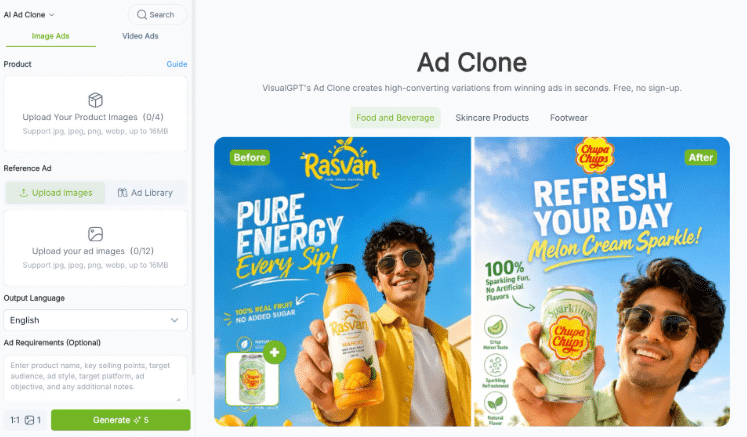
Here is how it works in practice. You find a competitor ad or one of your own past winners that performs. Upload that reference video or image to Ad Clone. The AI analyzes the hook placement, the pacing, the visual sequence, and the CTA structure. Then it rebuilds that same proven architecture around your product, your brand colors, and your messaging — generating multiple unique variations in minutes, not days.
An e-commerce seller I spoke with used to pay $150 per ad video to freelancers. With Ad Clone, they upload one winning competitor ad, swap in their own product, and get three test-ready variations in five minutes. Their conversion rate went up because they could afford to test more creatives — and they found winners faster.
A DTC brand founder with zero design skills put it this way: “I download winning ads I find online, upload the file to Ad Clone, and get a branded version in minutes. It is the creative partner I could never afford to hire on my budget.”
The math is straightforward. A freelancer costs $150-$400 per ad with a 3-5 day turnaround. AI-assisted ad cloning costs a fraction of that and delivers in minutes. For marketers running 20+ ad variations per month, the monthly savings hit four figures — and that is before factoring in the revenue lift from faster creative testing.
Pro Tip: Don’t wait until your current ad fatigue kicks in. Build a swipe file of 5 ads in your niche that look like they are performing well — look for ads running consistently for 14+ days, since sustained spend usually signals positive ROAS. Upload the best one to Ad Clone, generate 3 variations with your own product, and launch all 3 alongside your existing control ad at a small daily budget. Within 72 hours, you will know which structure your audience responds to. I have seen this approach cut cost per acquisition by 20-30% inside a week.
5 Infographics and Data Visuals That Earn Backlinks
Data-driven infographics generate 50% more backlinks on average than written content, according to Zebracat’s 2025 research. Backlinks drive organic traffic, and organic traffic compounds.
The old bottleneck was design production — a custom infographic from a professional designer costs $300-$800 and takes a week. AI tools reduce that to minutes. Feed your data points into a prompt, describe the visual style, and generate. You might still want a designer to polish the final version, but the heavy lifting is done. The same principle applies to ad clone — AI handles the structural work, your team adds the polish.
Choosing the Right Ad Clone and AI Visual Tool Stack
The AI visual tool market is crowded, which is both a blessing and a headache. Here is how I cut through the noise: pick one tool that handles text-to-image generation, image editing, background generation, and ad clone in a single dashboard. Juggling four subscriptions is a fast track to subscription fatigue.
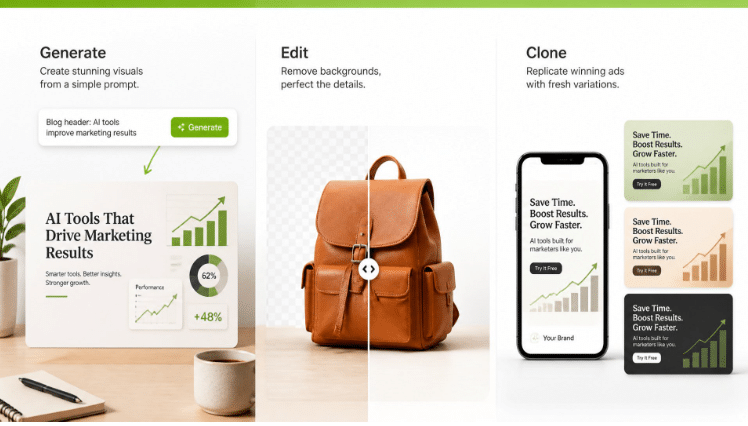
VisualGPT checks all four boxes — text-to-image generation, AI image editing (remove backgrounds, swap elements, expand images), product photography, and the Ad Clone tool for scaling your paid creative output. For a content marketer running a blog, social channels, and paid campaigns, it replaces a stack of tools with one login.
It is free to start, so you can test your first batch of blog images, social graphics, and ad variations without committing a dime.
Pro Tip: If you are only going to try one thing, start with ad clone. It delivers the fastest, most measurable ROI. Blog images and social graphics are important, but cloned ad creative directly impacts revenue. Test it first, then expand to your other visual needs once you see the numbers.
How to Measure Whether This Is Actually Working
You cannot improve what you do not measure. Here are the four numbers I track once AI visuals and ad clone are in the workflow:
Time per visual asset. Before AI: how long from request to final image? After AI: how long now? It should drop by at least 70%. If it does not, something in your workflow needs fixing.
Cost per visual asset. Include software, freelancer fees, and your own time at your hourly rate. If you were spending $4,000/month on freelance design and ad creative, and AI cuts that to under $500, that $3,500 drops straight to your bottom line.
Engagement per visual post. Track likes, shares, comments, and click-throughs on AI-generated posts versus stock image posts. Run this for at least 4 weeks. The data will tell you if your AI visuals are actually resonating — or if you need to tweak your prompts.
Creative refresh rate for paid ads. This is the one I watch closest. How many new ad variations are you testing per week? Before AI: maybe 3-5. With ad clone: aim for 10-15. Higher creative velocity means you find winners faster and ad fatigue hits slower. Top-performing accounts in 2025 refresh creative at least 3-5 times per week — and ad clone is the engine that makes that sustainable on a reasonable budget.
Final Thoughts
Here is what I have learned after watching dozens of marketers adopt AI visuals over the last year: the ones who win are not the ones with the biggest design budgets. They are the ones who remove friction fastest.
AI visual tools are not about replacing creativity. They are about removing every barrier between “I have an idea for a visual” and “that visual exists in the world.” When that gap shrinks from days to minutes, you publish more, you test more, your engagement goes up, and your cost per asset goes down. That is ROI you can measure — and it compounds.
The marketers who figure this out now are building visual content engines that keep working for months. Blog headers driving organic traffic. Ad clone pipelines keeping ROAS healthy with fresh creative. Social graphics earning shares long after they are posted.
If you have not tested an AI visual tool yet, do not overthink it. Generate your next 5 blog featured images. Clone one winning ad with Ad Clone and test it against your control. Compare the numbers.