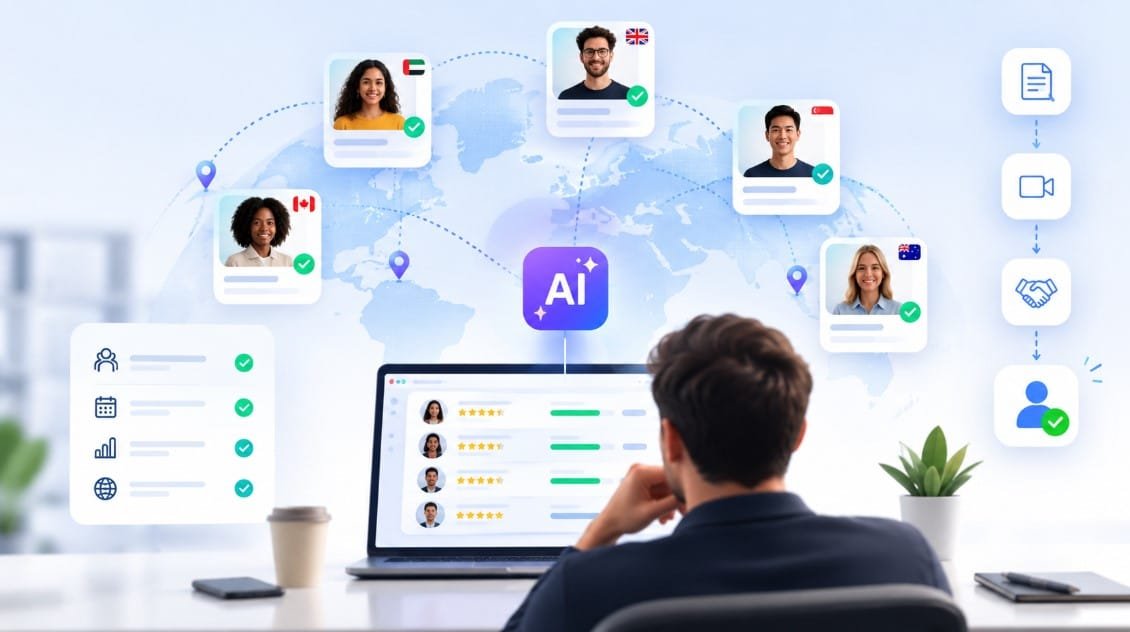
AI can find the perfect candidate in Lagos or Berlin in seconds. What happens after that is where most hiring stacks fall apart. The AI Hiring Stack Breakdown: How Global Recruiting Actually Works
A recruiting team in Dubai posts a senior engineering role. Within four hours, an AI sourcing tool has identified 340 qualified candidates across 22 countries, ranked them by skills match and sent personalised outreach to the top 50. By the end of the week, three have passed an AI-administered technical screen and the hiring manager has interview notes prepared by an AI summariser.
This is not a prediction. It is the workflow a growing number of companies are running right now.
But here is where the story usually gets complicated. The best candidate lives in Brazil. The hiring manager’s company has no legal entity in Brazil. Payroll doesn’t know how to process a Brazilian reais salary. Legal has questions about statutory benefits, termination rules and worker classification. A hire that took AI 90 minutes to surface is now stuck in a multi-week compliance queue.
The strongest AI hiring stack in 2026 is not the one with the most AI. It is the one with the fewest broken handoffs between the intelligence layer and the infrastructure layer. This piece breaks down both.
Related : Hiring in Brazil With Deel:The CLT Compliance Guide for Global Companies
Layer 1: AI Sourcing — Finding Talent Globally at Scale
Traditional recruiting started with a job board posting and waiting. AI-powered sourcing reversed that. Instead of attracting applicants, modern sourcing tools proactively identify candidates from LinkedIn, GitHub, industry databases and professional networks, then rank them by relevance to the role.
Tools like HireEZ, SeekOut, Fetcher and LinkedIn Recruiter’s AI features have made this accessible at different price points. The underlying approach is consistent: natural language processing parses the job description, machine learning identifies candidates whose documented skills, experience and career trajectory match the pattern, and automated personalised outreach begins — sometimes before a recruiter has manually reviewed a single profile.
The impact on hiring speed is real. LinkedIn’s 2025 Global Talent Trends report found that 72 percent of recruiters say AI-powered sourcing helps them find qualified candidates faster than traditional methods. Speed, however, creates its own problem: the candidate pool is now global by default, which means compliance complexity scales proportionally with sourcing quality.
Deel’s own 2026 Global Hiring Report — drawn from analysis of more than one million worker contracts across 37,000 companies in 150 countries — found that AI trainer roles grew 283 percent in cross-border hiring during 2025. AI is not just changing how companies hire; it is changing who they need to hire, and where those people happen to live.
Layer 2: AI Screening and Assessment — Speed with Scrutiny
Once the candidate pool is identified, AI handles the initial filter. Applicant tracking systems with AI screening — Greenhouse, Lever, Ashby, Workday — rank applications by relevance, flag potential red flags in career history and, in some implementations, generate written assessments of candidate fit before a human reads the CV.
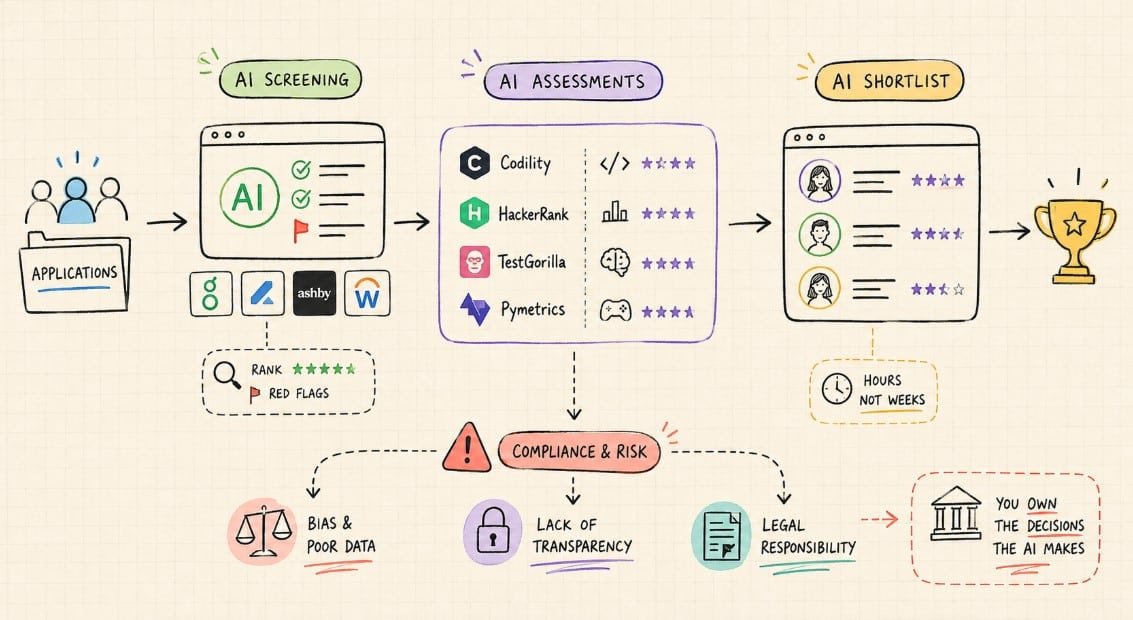
Skills-based assessment tools have matured significantly. Platforms like Codility and HackerRank run technical tests that no human recruiter needs to design or score. TestGorilla handles cognitive aptitude, personality and domain knowledge. Pymetrics uses behavioural game-based assessments. The output is a scored, ranked shortlist delivered in hours rather than weeks.
The speed advantage is substantial. The compliance risk is equally significant.
The International Labour Organization’s 2025 research argued that AI systems in HR produce poor results when their objectives are flawed, their data is biased or low-quality, or their programming is difficult to interpret. The U.S. Equal Employment Opportunity Commission has warned specifically that AI screening tools can create discrimination risks — including situations where applicants with disabilities are unfairly screened out in ways that violate employment law.
Companies using AI screening are not just adopting a productivity tool. They are taking on legal responsibility for the decisions those tools make.
Layer 3: AI Interviewing and Scheduling — Where the Human Question Gets Real
Asynchronous video interview platforms — HireVue being the most established, alongside Spark Hire and Modern Hire — allow candidates to record responses to structured questions at their own schedule, with AI analysing spoken responses, pace, word choice and in some implementations, facial expression.
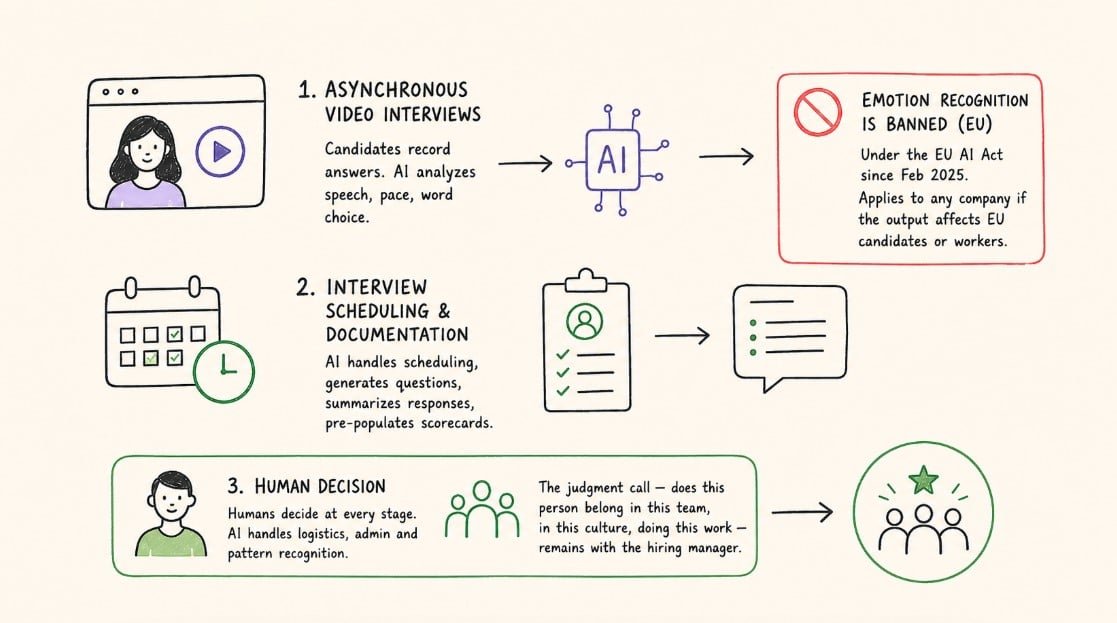
The facial expression element is where the EU drew the line. Emotion recognition in hiring has been banned under the EU AI Act since February 2025. Any company deploying emotion recognition technology to evaluate candidates — regardless of where the company is based, if the output affects EU candidates or workers — is operating outside the law. This applies equally to a US company screening candidates for a role in Germany.
Interview scheduling tools — Calendly AI, Metaview, Zoom’s AI Companion for meeting summaries — handle the coordination and documentation layer. Structured interview questions are generated by AI, responses are summarised, scorecards are pre-populated. The recruiter arrives at the interview with context prepared rather than having read 40 pages of notes.
The reasonable question throughout this layer is: where does the human actually decide? The answer, in well-run hiring stacks, is that humans are deciding at every stage. The AI is handling logistics, administration and pattern recognition. The judgment call — does this person belong in this team, in this culture, doing this work — remains with the hiring manager.
Layer 4: Compliance and Payroll Infrastructure — The Layer AI Cannot Replace
This is where most AI hiring stacks have a gap.
AI can identify a world-class candidate in Nairobi in 15 minutes. It cannot determine whether that candidate should be classified as an employee or contractor under Kenyan labour law. It cannot calculate statutory employer contributions, configure a compliant payroll in Kenyan shillings, or ensure that the employment contract meets local minimum-notice requirements. Those decisions require human judgment backed by local legal infrastructure.
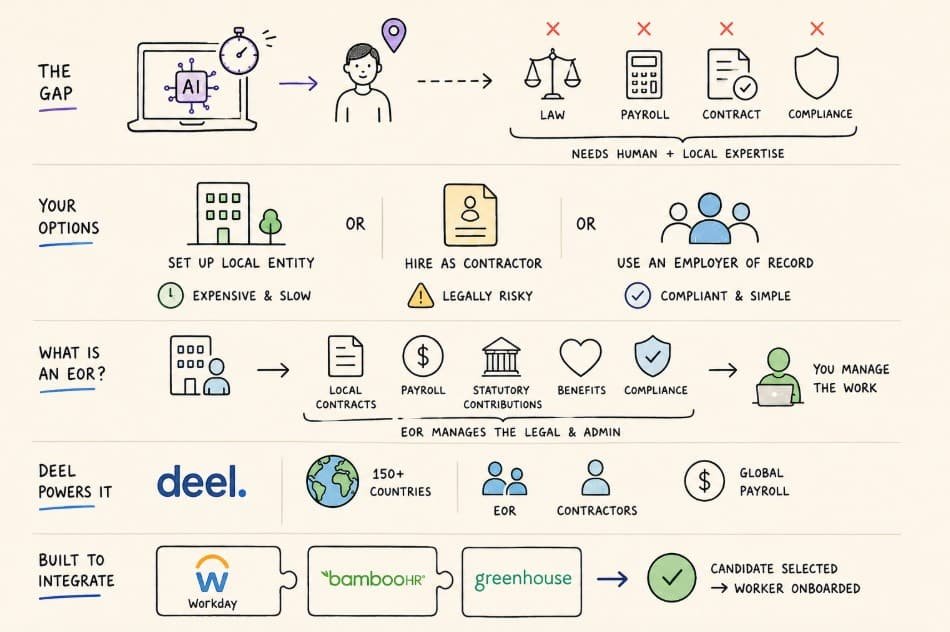
The options for companies without a local entity in the candidate’s country are essentially three: set up a local entity (expensive, slow, operationally complex), hire as an independent contractor (legally risky if the working relationship resembles employment), or use an Employer of Record.
An Employer of Record is a third-party company that legally employs the worker in their home country on behalf of the hiring company. The EOR handles local employment contracts, payroll, statutory contributions, benefits administration and ongoing compliance. The hiring company manages the worker’s day-to-day work; the EOR manages the legal and administrative relationship with the country.
This is the infrastructure layer that Deel has built at scale. Operating across 150 countries, Deel provides Employer of Record services, direct contractor management, and global payroll for companies that want to hire talent wherever the best person happens to live — without setting up a legal entity in every jurisdiction first.
Deel’s platform integrates with the HR and ATS systems that sit earlier in the hiring stack — Workday, BambooHR, Greenhouse — which means the transition from “candidate selected” to “worker onboarded” can happen within the same workflow rather than requiring a manual handoff to a different team using different software.
For companies hiring across multiple countries simultaneously, this matters enormously. A single company running AI-sourced hiring in six countries simultaneously would otherwise need to navigate six different compliance regimes, six payroll systems and six sets of employment contracts. The infrastructure layer consolidates that into one.
GET IN TOUCH
Schedule a Call With Deel’s team
The Regulatory Reality: AI Hiring Is Now a Governance Question
The window in which companies could deploy AI hiring tools without serious regulatory scrutiny is closing.
From August 2026, the EU AI Act’s provisions on high-risk AI systems are fully enforceable. Automated candidate ranking, shortlisting and CV scoring are classified as high-risk AI. Any European employer — or any company whose AI hiring tools affect EU candidates — must ensure transparency logs, human override mechanisms and documented bias audits. Fines for non-compliance reach €15 million or 3 percent of global annual turnover. For prohibited practices, fines reach €35 million or 7 percent of global turnover, exceeding GDPR’s maximum penalties.
In the United States, New York City’s Local Law 144 requires employers to conduct annual independent bias audits of any automated employment decision tools and to notify candidates about AI usage before deploying it in hiring. Audit results must be made publicly available. Several other US states have introduced or are considering similar legislation.
The practical implication is that an AI hiring tool is no longer just a productivity investment. It is a governance decision. Companies need to document what their AI tools are doing, what data they use, where human oversight exists and what happens when an automated recommendation is challenged.
| Jurisdiction | Regulation | Key requirement | Status |
| European Union | EU AI Act | Transparency logs, bias audits, human override — mandatory for high-risk AI | Enforceable August 2026 |
| New York City (US) | Local Law 144 | Annual bias audit, candidate notification, public disclosure | In force |
| United States (federal) | EEOC guidance | AI hiring tools must not create discriminatory outcomes | Guidance issued |
| Global (ILO) | ILO AI in HR research | AI objectives, data quality and transparency must be verified | Advisory |
Companies operating across multiple jurisdictions face a patchwork of requirements. A single global hiring workflow needs to be compliant in each country where candidates live or where work will be performed — not just where the hiring company is based.
What the Complete Stack Looks Like
The companies getting global hiring right in 2026 are not necessarily the ones with the most sophisticated AI tools. They are the ones who have connected their AI tools to infrastructure that can execute on the decisions the AI makes.
The workflow, mapped from beginning to end:
Workforce Planning
AI-assisted headcount analysis and skills gap identification.
Job Definition
AI-generated job descriptions optimised for clarity and equal opportunity compliance.
Sourcing
AI identifies global candidates and initiates personalised outreach.
Screening
AI ranks applications, runs skills assessments and surfaces recruiter shortlists.
Interviewing
AI-generated questions, video interviews and automated interview summaries.
Decision
Human hiring manager makes the final call using AI-prepared context.
Compliance Check
Determine whether the candidate should be engaged as an employee, contractor or through an EOR.
Onboarding
Contract, payroll, statutory contributions and benefits configured locally.
Ongoing Management
Monthly payroll, compliance monitoring and renewals managed in the local framework.
The handoff between steps seven and eight is where most companies currently have a gap. AI has no ability to resolve this. The question of whether a worker in Vietnam should be employed as a contractor or through an EOR requires legal knowledge of Vietnamese labour law, an understanding of the working relationship’s substance and a mechanism to actually execute either option. That is infrastructure, not intelligence.
The Takeaway
AI is genuinely transforming hiring. The speed gains in sourcing, screening and administrative coordination are real, measurable and increasingly accessible to companies that are not large enterprises. A ten-person startup in Dubai can now run a hiring process that would have required a dedicated recruiter headcount five years ago.
But the promise of global AI-powered hiring is only delivered when the back-end infrastructure can close the loop. A candidate sourced in Brazil who cannot be legally and efficiently onboarded is not a hiring success — it is an incomplete workflow.
The question for any team building or evaluating a hiring stack in 2026 is not only which AI tools to use at the front end. It is what happens at the moment of hire, and whether the infrastructure exists to turn a great candidate anywhere in the world into a legally employed, correctly paid worker without a multi-week compliance scramble.
For teams who want to solve that part of the problem, Deel is worth evaluating as the compliance and payroll infrastructure layer. EOR in 150 countries, direct contractor management, global payroll in 90 countries, and integrations with the HR tools most teams already use. The full platform overview is here.
Disclosure
This article contains a referral link. We may earn a commission if a qualifying subscription is purchased through the link above. All editorial content, data and analysis in this article is independent and based on publicly available sources.